Mud Lake Fishing Report
Synthesis generated comprehensive plan with professional recommendations.
Mud Lake Fishing Report
Generated Apr 9, 2026, 3:40 PM.
Key fishing read
- Day 1: High pressure (1013mb) - tougher bite, use finesse tactics
- Day 1: High winds (17mph) - seek protected areas, use heavier lures
- Day 1: Clear, High: 68°F, Low: 35°F
- Day 2: High pressure (1008mb) - tougher bite, use finesse tactics
- Day 2: High winds (28mph) - seek protected areas, use heavier lures
- Day 2: MostlyCloudy, High: 72°F, Low: 41°F
- Day 3: High pressure (1004mb) - tougher bite, use finesse tactics
- Day 3: High winds (35mph) - seek protected areas, use heavier lures
Tool analysis details
Analyze Weather Conditions
Weather analysis for Mud Lake completed
Findings:
- Day 1: High pressure (1013mb) - tougher bite, use finesse tactics
- Day 1: High winds (17mph) - seek protected areas, use heavier lures
- Day 1: Clear, High: 68°F, Low: 35°F
- Day 2: High pressure (1008mb) - tougher bite, use finesse tactics
- Day 2: High winds (28mph) - seek protected areas, use heavier lures
Lure Matrix Wind Clarity
Lure guidance for wind=windy, clarity=unknown, phase=fall.
Findings:
- Max thump: giant spinnerbaits, slow roll, contact cover
- Fall: chase baitfish in creeks; spinnerbaits/lipless cranks to cover water
Analyze Solunar Timing
Solunar timing analysis for Mud Lake completed
Findings:
- 2026-04-09 Major feeding periods: 06:44 AM - 09:14 AM, 04:04 PM - 06:34 PM
- 2026-04-09 Minor feeding periods: 02:37 AM - 04:07 AM, 10:56 AM - 12:26 PM
- 2026-04-10 Major feeding periods: 07:34 AM - 10:04 AM, 04:54 PM - 07:24 PM
- 2026-04-10 Minor feeding periods: 03:14 AM - 04:44 AM, 12:01 PM - 01:31 PM
- 2026-04-11 Major feeding periods: 08:23 AM - 10:53 AM, 05:42 PM - 08:12 PM
Estimate Seasonal Phase
Season estimate for Mud Lake: fall.
Findings:
- Estimated phase: fall
- Temp change over window: -28.5°F
Analyze Species Behavior
Species behavior analysis for Mud Lake completed
Findings:
- Largemouth bass: Sluggish in cold water (45.0°F), target deep structure with slow presentations
- Largemouth bass: Spring pre-spawn/spawn mode - target shallow flats and protected coves
- Smallmouth bass: Sluggish in cold water (45.0°F), target deep structure with slow presentations
- Smallmouth bass: Spring pre-spawn/spawn mode - target shallow flats and protected coves
- Largemouth bass: sluggish activity at 45.0°F (optimal: 60-75°F)
Analyze Thermal Patterns
1. Overall Thermal Landscape Summary
- Assumed Orientation: North is at the top of the image.
- Major Visual Anchors:
- The Western Basin: A long, elongated body of water oriented roughly East-West.
- The Eastern Basin: A larger, more irregular body of water located to the East, featuring a prominent northern "arm" or inlet.
- Thermal Summary: The lake is dominated by Dark Blue (42-46°F / 6-8°C), indicating late winter/early spring conditions. There is a distinct, colder Very Dark Navy Blue (40-42°F / 4-6°C) channel running through the center of the Eastern Basin. Minor warming is visible along the immediate shorelines in Medium Blue (46-52°F / 8-11°C).
- Temperature Range: Approximately 40°F to 52°F (4°C to 11°C).
2. Detailed Thermal Feature Analysis
Temperature Breaks
- The Central Channel Break: In the Eastern Basin, there is a sharp, linear transition from the Dark Blue (42-46°F) main body to a Very Dark Navy Blue (40-42°F) core. This represents a significant thermal boundary where the coldest water is concentrated in the center of the basin.
- Shoreline Transitions: Along the southern edge of the Western Basin and the southern perimeter of the Eastern Basin, there is a visible transition from the Dark Blue (42-46°F) main water to a Medium Blue (46-52°F) fringe. This indicates the water is warming slightly as it interacts with the shoreline.
Pockets/Patches
- Western Basin Fringe: The southern shoreline of the Western Basin shows a consistent, narrow band of Medium Blue (46-52°F). This is the warmest water visible in the western section of the lake.
Gradients
- Eastern Basin Warming: The northern "arm" of the Eastern Basin shows a gradual transition from the colder Dark Blue (42-46°F) center toward the slightly warmer Medium Blue (46-52°F) edges, suggesting the shallow water near the northern shore is absorbing more heat.
Uniform Areas
- Main Body: The vast majority of the lake is a uniform Dark Blue (42-46°F), indicating that the bulk of the water column is currently in a stable, cold, late-winter state.
3. Insightful Fish Behavior Interpretation
- Sluggish Metabolism: With the majority of the lake in the 42-46°F (6-8°C) range, fish will be in a "winter mode." Expect minimal movement and very slow feeding windows.
- Thermal Seeking: Fish will likely be attracted to the Medium Blue (46-52°F / 8-11°C) fringes along the shorelines. These areas represent the "warmest" available water, which may trigger slightly higher activity levels compared to the colder, central basin water.
- Avoidance: The Very Dark Navy Blue (40-42°F / 4-6°C) channel in the Eastern Basin is likely the least productive area, as it represents the coldest surface water where fish will be most lethargic.
4. Satellite Correlation Analysis
- Shoreline Interaction: The Medium Blue (46-52°F) fringes correlate perfectly with the immediate shoreline boundaries. This confirms that the shallow water near the banks is warming faster than the open water, likely due to solar radiation on the shoreline substrate.
- Channel Identification: The Very Dark Navy Blue (40-42°F) core in the Eastern Basin appears to follow the deepest part of the basin, suggesting that the coldest water is concentrated in the deepest, most stable areas of the lake.
5. Actionable Fishing Recommendations
- Target the Fringes: Focus your efforts on the Medium Blue (46-52°F) zones identified along the southern shorelines of both basins. These are your best opportunities for finding active fish.
- Slow Presentations: Given the overall cold temperatures (42-46°F), use slow-moving, finesse-style baits. Fish will not be chasing fast-moving lures in this temperature range.
- Avoid the Center: Steer clear of the Very Dark Navy Blue (40-42°F) central channel in the Eastern Basin; the water here is likely too cold to support active feeding.
- Sunlight Utilization: Target the northern shore of the Eastern Basin during the afternoon, as this area shows a gradient toward the Medium Blue (46-52°F) range, indicating it is receiving the most direct solar warming.
Findings:
- Current surface temperature: 45.0°F. Fish metabolism significantly reduced in cold water. Target sunny, protected shorelines and use extremely slow presentations. Focus on midday when surface temperatures are warmest.
-
1. Overall Thermal Landscape Summary
- Assumed Orientation: North is at the top of the image.
- Major Visual Anchors:
- The Western Basin: A long, elongated body of water oriented roughly East-West.
- The Eastern Basin: A larger, more irregular body of water located to the East, featuring a prominent northern "arm" or inlet.
- Thermal Summary: The lake is dominated by Dark Blue (42-46°F / 6-8°C), indicating late winter/early spring conditions. There is a distinct, colder Very Dark Navy Blue (40-42°F / 4-6°C) channel running through the center of the Eastern Basin. Minor warming is visible along the immediate shorelines in Medium Blue (46-52°F / 8-11°C).
- Temperature Range: Approximately 40°F to 52°F (4°C to 11°C).
2. Detailed Thermal Feature Analysis
Temperature Breaks
- The Central Channel Break: In the Eastern Basin, there is a sharp, linear transition from the Dark Blue (42-46°F) main body to a Very Dark Navy Blue (40-42°F) core. This represents a significant thermal boundary where the coldest water is concentrated in the center of the basin.
- Shoreline Transitions: Along the southern edge of the Western Basin and the southern perimeter of the Eastern Basin, there is a visible transition from the Dark Blue (42-46°F) main water to a Medium Blue (46-52°F) fringe. This indicates the water is warming slightly as it interacts with the shoreline.
Pockets/Patches
- Western Basin Fringe: The southern shoreline of the Western Basin shows a consistent, narrow band of Medium Blue (46-52°F). This is the warmest water visible in the western section of the lake.
Gradients
- Eastern Basin Warming: The northern "arm" of the Eastern Basin shows a gradual transition from the colder Dark Blue (42-46°F) center toward the slightly warmer Medium Blue (46-52°F) edges, suggesting the shallow water near the northern shore is absorbing more heat.
Uniform Areas
- Main Body: The vast majority of the lake is a uniform Dark Blue (42-46°F), indicating that the bulk of the water column is currently in a stable, cold, late-winter state.
3. Insightful Fish Behavior Interpretation
- Sluggish Metabolism: With the majority of the lake in the 42-46°F (6-8°C) range, fish will be in a "winter mode." Expect minimal movement and very slow feeding windows.
- Thermal Seeking: Fish will likely be attracted to the Medium Blue (46-52°F / 8-11°C) fringes along the shorelines. These areas represent the "warmest" available water, which may trigger slightly higher activity levels compared to the colder, central basin water.
- Avoidance: The Very Dark Navy Blue (40-42°F / 4-6°C) channel in the Eastern Basin is likely the least productive area, as it represents the coldest surface water where fish will be most lethargic.
4. Satellite Correlation Analysis
- Shoreline Interaction: The Medium Blue (46-52°F) fringes correlate perfectly with the immediate shoreline boundaries. This confirms that the shallow water near the banks is warming faster than the open water, likely due to solar radiation on the shoreline substrate.
- Channel Identification: The Very Dark Navy Blue (40-42°F) core in the Eastern Basin appears to follow the deepest part of the basin, suggesting that the coldest water is concentrated in the deepest, most stable areas of the lake.
5. Actionable Fishing Recommendations
- Target the Fringes: Focus your efforts on the Medium Blue (46-52°F) zones identified along the southern shorelines of both basins. These are your best opportunities for finding active fish.
- Slow Presentations: Given the overall cold temperatures (42-46°F), use slow-moving, finesse-style baits. Fish will not be chasing fast-moving lures in this temperature range.
- Avoid the Center: Steer clear of the Very Dark Navy Blue (40-42°F) central channel in the Eastern Basin; the water here is likely too cold to support active feeding.
- Sunlight Utilization: Target the northern shore of the Eastern Basin during the afternoon, as this area shows a gradient toward the Medium Blue (46-52°F) range, indicating it is receiving the most direct solar warming.
- Spring warming: Focus on shallow bays and areas showing the warmest surface temperatures in thermal imagery as fish move into spawning areas.
Analyze Water Clarity
This analysis integrates the provided Chlorophyll (MCI) and Sediment (TSS) imagery to provide a tactical guide for Mud Lake.
1. Overall Water Quality Summary
The lake exhibits a stark dichotomy. The western arm is characterized by low chlorophyll and low sediment (Deep Blue/Teal), indicating high-clarity, oligotrophic conditions. Conversely, the large eastern basin is dominated by high chlorophyll and high sediment (Yellow/Orange/Red), indicating a eutrophic, turbid environment. This suggests a significant nutrient or runoff inflow point located on the eastern side of the lake.
2. Detailed Clarity Zone Mapping
- Zone A: The Western Basin (Deep Blue/Teal)
- Matrix Position: Bottom-Left (Low Sediment/Low Chlorophyll).
- Conditions: 15-25+ feet visibility.
- Tactical Implication: High-pressure zone. Fish will be wary. Use fluorocarbon line, natural colors (green pumpkin, shad), and finesse presentations (Ned rigs, drop shots).
- Zone B: The Transition Neck (Green/Yellow)
- Matrix Position: Bottom-Center to Bottom-Right.
- Conditions: 4-10 feet visibility.
- Tactical Implication: The "Goldilocks" zone. Fish are active but not spooked. Ideal for moving baits like spinnerbaits or swimbaits.
- Zone C: The Eastern Main Basin (Yellow/Orange/Red)
- Matrix Position: Top-Right (High Chlorophyll/High Sediment).
- Conditions: <2-4 feet visibility.
- Tactical Implication: Power fishing territory. Fish rely on vibration and sound. Use loud rattles, large profiles, and high-contrast colors (chartreuse, black/blue).
3. Turbidity/Algae Sources & Transition Zones
- Source Identification: The intense red/orange saturation in the eastern basin points to a major nutrient inflow, likely a creek or agricultural runoff point on the eastern shoreline.
- Clarity Breaks: A sharp transition line exists where the western arm meets the eastern basin. This "mudline" is a high-percentage ambush point. Predators will likely stage in the clearer water of the western arm, facing into the turbid water to ambush baitfish disoriented by the lower visibility.
4. Species-Specific Clarity Strategy
- Bass: Target the Transition Neck (Zone B). Bass will use the edge of the turbidity as a visual shield. Work the edge with a vibrating jig (Chatterbait) to bridge the gap between the clear and stained water.
- Sight-Feeders (Walleye/Pike): Focus on the Western Basin (Zone A). These species will utilize the superior visibility to hunt. Use long casts and natural-colored jerkbaits.
- Panfish/Crappie: Target the Eastern Basin (Zone C). Crappie often thrive in stained, nutrient-rich water. Use small jigs with high-vibration tails or scent-enhanced plastics to help them locate the bait in the low-visibility conditions.
5. Tactical Fishing Adjustments
- Clear Zone (West): Stealth is paramount. Use 8-10lb fluorocarbon. Long casts are mandatory. Avoid heavy trolling motor use.
- Transition Zone (Neck): Use 12lb line. Focus on "searching" with reaction baits. If the bite is slow, switch to a finesse presentation but keep the color profile slightly brighter (e.g., chartreuse-tipped tail).
- Turbid Zone (East): Use 15-20lb braid or heavy mono. Aggressive boat positioning is acceptable. Use baits that displace water (Colorado blade spinnerbaits) and maximize noise.
6. Seasonal Context
The visual pattern—specifically the intense, widespread red/orange bloom in the eastern basin—is highly characteristic of late summer or early autumn. The clear western arm suggests that the lake has a significant deep-water component or a spring-fed source that maintains clarity, providing a "refuge" for fish when the eastern basin becomes overly choked with algae and sediment. The sharp contrast suggests the lake is currently experiencing a stable, stratified condition rather than a recent, lake-wide turnover event.
Findings:
- This analysis integrates the provided Chlorophyll (MCI) and Sediment (TSS) imagery to provide a tactical guide for Mud Lake.
1. Overall Water Quality Summary
The lake exhibits a stark dichotomy. The western arm is characterized by low chlorophyll and low sediment (Deep Blue/Teal), indicating high-clarity, oligotrophic conditions. Conversely, the large eastern basin is dominated by high chlorophyll and high sediment (Yellow/Orange/Red), indicating a eutrophic, turbid environment. This suggests a significant nutrient or runoff inflow point located on the eastern side of the lake.
2. Detailed Clarity Zone Mapping
- Zone A: The Western Basin (Deep Blue/Teal)
- Matrix Position: Bottom-Left (Low Sediment/Low Chlorophyll).
- Conditions: 15-25+ feet visibility.
- Tactical Implication: High-pressure zone. Fish will be wary. Use fluorocarbon line, natural colors (green pumpkin, shad), and finesse presentations (Ned rigs, drop shots).
- Zone B: The Transition Neck (Green/Yellow)
- Matrix Position: Bottom-Center to Bottom-Right.
- Conditions: 4-10 feet visibility.
- Tactical Implication: The "Goldilocks" zone. Fish are active but not spooked. Ideal for moving baits like spinnerbaits or swimbaits.
- Zone C: The Eastern Main Basin (Yellow/Orange/Red)
- Matrix Position: Top-Right (High Chlorophyll/High Sediment).
- Conditions: <2-4 feet visibility.
- Tactical Implication: Power fishing territory. Fish rely on vibration and sound. Use loud rattles, large profiles, and high-contrast colors (chartreuse, black/blue).
3. Turbidity/Algae Sources & Transition Zones
- Source Identification: The intense red/orange saturation in the eastern basin points to a major nutrient inflow, likely a creek or agricultural runoff point on the eastern shoreline.
- Clarity Breaks: A sharp transition line exists where the western arm meets the eastern basin. This "mudline" is a high-percentage ambush point. Predators will likely stage in the clearer water of the western arm, facing into the turbid water to ambush baitfish disoriented by the lower visibility.
4. Species-Specific Clarity Strategy
- Bass: Target the Transition Neck (Zone B). Bass will use the edge of the turbidity as a visual shield. Work the edge with a vibrating jig (Chatterbait) to bridge the gap between the clear and stained water.
- Sight-Feeders (Walleye/Pike): Focus on the Western Basin (Zone A). These species will utilize the superior visibility to hunt. Use long casts and natural-colored jerkbaits.
- Panfish/Crappie: Target the Eastern Basin (Zone C). Crappie often thrive in stained, nutrient-rich water. Use small jigs with high-vibration tails or scent-enhanced plastics to help them locate the bait in the low-visibility conditions.
5. Tactical Fishing Adjustments
- Clear Zone (West): Stealth is paramount. Use 8-10lb fluorocarbon. Long casts are mandatory. Avoid heavy trolling motor use.
- Transition Zone (Neck): Use 12lb line. Focus on "searching" with reaction baits. If the bite is slow, switch to a finesse presentation but keep the color profile slightly brighter (e.g., chartreuse-tipped tail).
- Turbid Zone (East): Use 15-20lb braid or heavy mono. Aggressive boat positioning is acceptable. Use baits that displace water (Colorado blade spinnerbaits) and maximize noise.
6. Seasonal Context
The visual pattern—specifically the intense, widespread red/orange bloom in the eastern basin—is highly characteristic of late summer or early autumn. The clear western arm suggests that the lake has a significant deep-water component or a spring-fed source that maintains clarity, providing a "refuge" for fish when the eastern basin becomes overly choked with algae and sediment. The sharp contrast suggests the lake is currently experiencing a stable, stratified condition rather than a recent, lake-wide turnover event.
Analyze Satellite Imagery
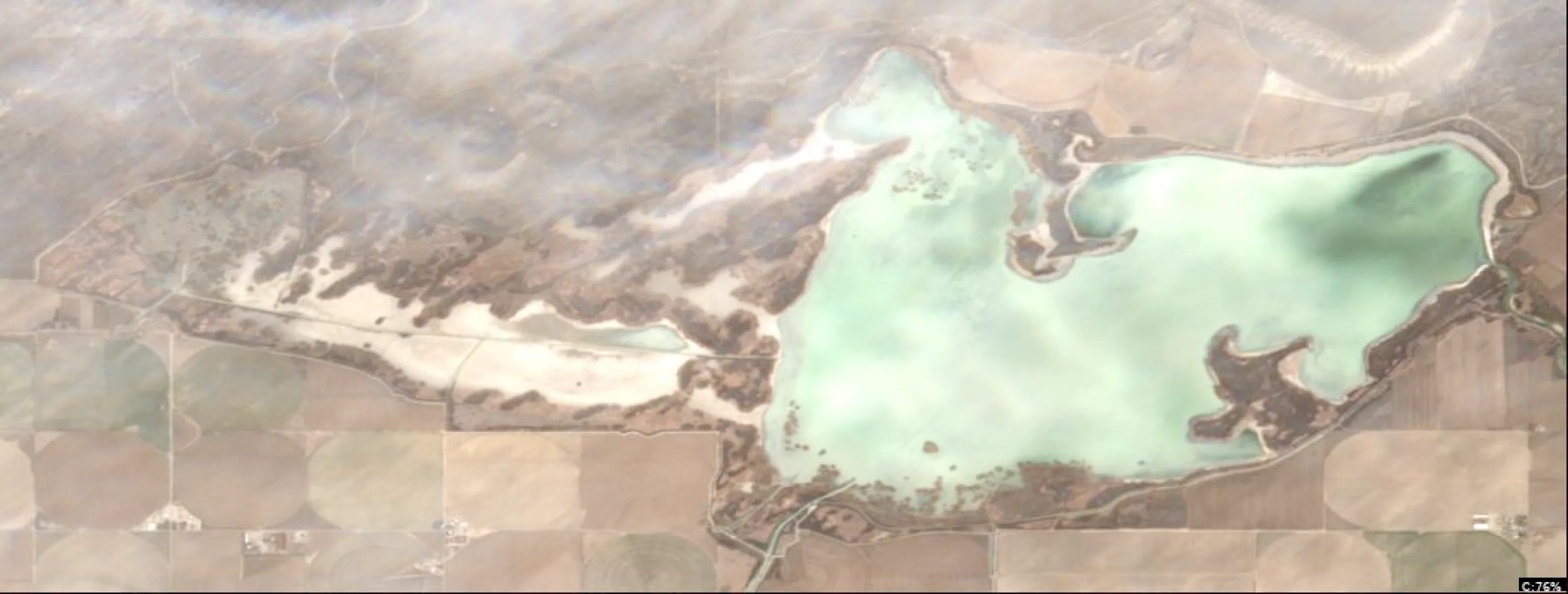
This analysis of Mud Lake, Idaho, is based on the provided satellite imagery. Mud Lake is a shallow, irrigation-fed reservoir characterized by high turbidity and extensive mud flats. Given the current water temperature of 45°F, fish will be lethargic and seeking the most stable water conditions available.
1. LAKE OVERVIEW
Mud Lake is essentially a large, shallow basin with a distinct "Main Lake" body to the east and a long, narrow, highly irregular "Western Arm" that stretches toward the agricultural fields.
- Main Lake Body: The eastern portion is the deepest and most open section, featuring a large, rounded basin.
- Western Arm: A long, shallow, serpentine section characterized by extensive mud flats and narrow channels.
- Major Landmarks: The primary access points are located along the southern shoreline where road infrastructure meets the water. The lake is surrounded by circular pivot irrigation fields, which contribute to the sediment-heavy, light-colored water appearance.
2. FINDABLE FISHING SPOTS
Spot 1: The Eastern Basin "Deep" Pocket
- General Area: Main Lake (Easternmost section).
- How to Find It: Navigate to the far eastern edge of the main lake body.
- What You See: The darkest water in the entire lake, indicating the deepest point of the basin.
- Why Fish It: At 45°F, fish will gravitate toward the deepest available water to find the most stable temperature.
- Best Approach: Vertical jigging or slow-moving bottom baits.
Spot 2: The Central Island Point
- General Area: Main Lake (Center-North).
- How to Find It: Locate the prominent peninsula/island structure protruding from the northern shore into the main basin.
- What You See: A distinct point with a sharp color transition from light tan to medium blue.
- Why Fish It: This is a primary structural feature that breaks the current and provides a transition zone for fish moving between shallow flats and the main basin.
- Best Approach: Cast parallel to the point, working from the shallow tan water out toward the darker blue water.
Spot 3: The Southern Inlet Channel
- General Area: Southern Shoreline (Central).
- How to Find It: Look for the distinct channel cut entering the lake from the southern shore, near the road access.
- What You See: A dark, narrow, serpentine line cutting through the lighter-colored mud flats.
- Why Fish It: This channel acts as a highway for fish moving from the deeper main lake into the shallower, warming flats.
- Best Approach: Work the edges of the channel with slow-moving lures.
Spot 4: The Western Arm "Neck-Down"
- General Area: Western Arm (Mid-section).
- How to Find It: Follow the western arm until the water narrows significantly between two points of land.
- What You See: A constriction point where the light-colored shallow water is forced through a narrow gap.
- Why Fish It: Any movement of water through this gap will concentrate baitfish and predators.
- Best Approach: Position the boat in the wider section and cast into the narrowest part of the gap.
Spot 5: The Southwest Cove
- General Area: Western Arm (Southwest corner).
- How to Find It: Follow the southern shoreline of the western arm to the furthest reachable pocket.
- What You See: A protected, irregular-shaped cove with darker water patches.
- Why Fish It: These areas are protected from wind and will warm up the fastest on sunny spring days, potentially drawing fish in to feed.
- Best Approach: Slow, methodical casting into the dark patches.
3. VISIBLE FEATURES BY SECTION
- Main Lake Body:
- Eastern Basin: Deepest water, primary thermal refuge.
- Northern Peninsula: Major structural point, high-percentage area for transition fish.
- Western Arm:
- Southern Shoreline: Multiple small, dark-water pockets and inlets.
- Mid-Arm Constriction: Narrow channel that funnels water and fish.
- Western Flats: Extensive light-colored, shallow mud flats (likely too shallow for active fish in 45°F water).
4. PRACTICAL FISHING GUIDANCE
- Progression:
- Start: Begin in the Main Lake Eastern Basin. The water is deepest here, and at 45°F, fish will be holding tight to the bottom in the deepest water available.
- Mid-Day: As the sun hits the water, move to the Central Island Point or the Southern Inlet Channel. These areas will warm up slightly faster than the deep basin.
- Pattern: Focus on "edge fishing." Because the lake is so shallow and turbid, fish will be holding on the distinct color transitions where the light-colored mud flats drop into the darker, deeper channels.
- Navigation: Use extreme caution. The light-colored areas in the satellite imagery are extremely shallow mud flats. Stay within the darker, blue-toned channels to avoid grounding your boat. The transition from the Main Lake to the Western Arm is narrow; follow the darker water path carefully.
Findings:
- This analysis of Mud Lake, Idaho, is based on the provided satellite imagery. Mud Lake is a shallow, irrigation-fed reservoir characterized by high turbidity and extensive mud flats. Given the current water temperature of 45°F, fish will be lethargic and seeking the most stable water conditions available.
1. LAKE OVERVIEW
Mud Lake is essentially a large, shallow basin with a distinct "Main Lake" body to the east and a long, narrow, highly irregular "Western Arm" that stretches toward the agricultural fields.
- Main Lake Body: The eastern portion is the deepest and most open section, featuring a large, rounded basin.
- Western Arm: A long, shallow, serpentine section characterized by extensive mud flats and narrow channels.
- Major Landmarks: The primary access points are located along the southern shoreline where road infrastructure meets the water. The lake is surrounded by circular pivot irrigation fields, which contribute to the sediment-heavy, light-colored water appearance.
2. FINDABLE FISHING SPOTS
Spot 1: The Eastern Basin "Deep" Pocket
- General Area: Main Lake (Easternmost section).
- How to Find It: Navigate to the far eastern edge of the main lake body.
- What You See: The darkest water in the entire lake, indicating the deepest point of the basin.
- Why Fish It: At 45°F, fish will gravitate toward the deepest available water to find the most stable temperature.
- Best Approach: Vertical jigging or slow-moving bottom baits.
Spot 2: The Central Island Point
- General Area: Main Lake (Center-North).
- How to Find It: Locate the prominent peninsula/island structure protruding from the northern shore into the main basin.
- What You See: A distinct point with a sharp color transition from light tan to medium blue.
- Why Fish It: This is a primary structural feature that breaks the current and provides a transition zone for fish moving between shallow flats and the main basin.
- Best Approach: Cast parallel to the point, working from the shallow tan water out toward the darker blue water.
Spot 3: The Southern Inlet Channel
- General Area: Southern Shoreline (Central).
- How to Find It: Look for the distinct channel cut entering the lake from the southern shore, near the road access.
- What You See: A dark, narrow, serpentine line cutting through the lighter-colored mud flats.
- Why Fish It: This channel acts as a highway for fish moving from the deeper main lake into the shallower, warming flats.
- Best Approach: Work the edges of the channel with slow-moving lures.
Spot 4: The Western Arm "Neck-Down"
- General Area: Western Arm (Mid-section).
- How to Find It: Follow the western arm until the water narrows significantly between two points of land.
- What You See: A constriction point where the light-colored shallow water is forced through a narrow gap.
- Why Fish It: Any movement of water through this gap will concentrate baitfish and predators.
- Best Approach: Position the boat in the wider section and cast into the narrowest part of the gap.
Spot 5: The Southwest Cove
- General Area: Western Arm (Southwest corner).
- How to Find It: Follow the southern shoreline of the western arm to the furthest reachable pocket.
- What You See: A protected, irregular-shaped cove with darker water patches.
- Why Fish It: These areas are protected from wind and will warm up the fastest on sunny spring days, potentially drawing fish in to feed.
- Best Approach: Slow, methodical casting into the dark patches.
3. VISIBLE FEATURES BY SECTION
- Main Lake Body:
- Eastern Basin: Deepest water, primary thermal refuge.
- Northern Peninsula: Major structural point, high-percentage area for transition fish.
- Western Arm:
- Southern Shoreline: Multiple small, dark-water pockets and inlets.
- Mid-Arm Constriction: Narrow channel that funnels water and fish.
- Western Flats: Extensive light-colored, shallow mud flats (likely too shallow for active fish in 45°F water).
4. PRACTICAL FISHING GUIDANCE
- Progression:
- Start: Begin in the Main Lake Eastern Basin. The water is deepest here, and at 45°F, fish will be holding tight to the bottom in the deepest water available.
- Mid-Day: As the sun hits the water, move to the Central Island Point or the Southern Inlet Channel. These areas will warm up slightly faster than the deep basin.
- Pattern: Focus on "edge fishing." Because the lake is so shallow and turbid, fish will be holding on the distinct color transitions where the light-colored mud flats drop into the darker, deeper channels.
- Navigation: Use extreme caution. The light-colored areas in the satellite imagery are extremely shallow mud flats. Stay within the darker, blue-toned channels to avoid grounding your boat. The transition from the Main Lake to the Western Arm is narrow; follow the darker water path carefully.
How this was synthesized
Professional fishing guide analysis integrating 8 tools: analyze_weather_conditions, lure_matrix_wind_clarity, analyze_solunar_timing, estimate_seasonal_phase, analyze_species_behavior, analyze_thermal_patterns, analyze_water_clarity, analyze_satellite_imagery. User request: 'Generate a comprehensive fishing report for Mud Lake. Use tools to analyze satellite structure, thermal patterns, water clarity, weather, and solunar timing, then synthesize a concise plan.'. Synthesis generated comprehensive plan with professional recommendations.