Lake Piru Fishing Report
Synthesis generated comprehensive plan with professional recommendations.
Lake Piru Fishing Report
Generated Mar 21, 2026, 8:30 AM.
Key fishing read
- Day 1: High pressure (1013mb) - tougher bite, use finesse tactics
- Day 1: High winds (16mph) - seek protected areas, use heavier lures
- Day 1: Clear, High: 97°F, Low: 66°F
- Day 2: High pressure (1013mb) - tougher bite, use finesse tactics
- Day 2: High winds (17mph) - seek protected areas, use heavier lures
- Day 2: MostlyCloudy, High: 86°F, Low: 59°F
- Day 3: High pressure (1012mb) - tougher bite, use finesse tactics
- Day 3: High winds (17mph) - seek protected areas, use heavier lures
Tool analysis details
Analyze Weather Conditions
Weather analysis for Lake Piru completed
Findings:
- Day 1: High pressure (1013mb) - tougher bite, use finesse tactics
- Day 1: High winds (16mph) - seek protected areas, use heavier lures
- Day 1: Clear, High: 97°F, Low: 66°F
- Day 2: High pressure (1013mb) - tougher bite, use finesse tactics
- Day 2: High winds (17mph) - seek protected areas, use heavier lures
Lure Matrix Wind Clarity
Lure guidance for wind=windy, clarity=unknown, phase=fall.
Findings:
- Max thump: giant spinnerbaits, slow roll, contact cover
- Fall: chase baitfish in creeks; spinnerbaits/lipless cranks to cover water
Analyze Solunar Timing
Solunar timing analysis for Lake Piru completed
Findings:
- 2026-03-20 Major feeding periods: 01:56 PM - 04:26 PM, 12:00 AM - 12:00 AM
- 2026-03-20 Minor feeding periods: 07:12 AM - 08:42 AM, 08:52 PM - 10:22 PM
- 2026-03-21 Major feeding periods: 02:49 PM - 05:19 PM, 12:00 AM - 12:00 AM
- 2026-03-21 Minor feeding periods: 07:45 AM - 09:15 AM, 10:05 PM - 11:35 PM
- 2026-03-22 Major feeding periods: 03:46 PM - 06:16 PM, 12:00 AM - 12:00 AM
Analyze Species Behavior
Species behavior analysis for Lake Piru completed
Findings:
- Largemouth bass: Spring pre-spawn/spawn mode - target shallow flats and protected coves
- Black crappie: Pre-spawn/spawn temps (56.0°F), target shallow cover with small jigs
- Largemouth bass: sluggish activity at 56.0°F (optimal: 60-75°F)
- Rainbow trout: peak activity at 56.0°F (optimal: 45-65°F)
- Channel catfish: sluggish activity at 56.0°F (optimal: 65-85°F)
Estimate Seasonal Phase
Season estimate for Lake Piru: fall.
Findings:
- Estimated phase: fall
- Temp change over window: -28.1°F
Analyze Thermal Patterns
1. Overall Thermal Landscape Summary
- Assumed Orientation: North is at the top of the image.
- Major Visual Anchors:
- The Northern Channel: A long, narrow, finger-like extension reaching toward the top of the image.
- The Central Basin: The wider, primary body of water located in the middle of the image.
- The Eastern Hook: A distinct, curved protrusion extending from the southeastern section of the main basin.
- Thermal Summary: The lake is dominated by cold-water signatures, ranging from Very Dark Navy Blue (40-42°F / 4-6°C) to Light Blue (52-56°F / 11-13°C). The vast majority of the central basin is in the 40-46°F range, indicating late-winter/early-spring conditions.
2. Detailed Thermal Feature Analysis
Temperature Breaks
- The Western Transition: A sharp, abrupt break exists along the western edge of the central basin, where the water shifts from Dark Blue (42-46°F) to Light Blue (52-56°F). This represents a significant 10°F thermal boundary.
- The Eastern Hook Interface: The base of the "hook" on the eastern side shows a clear transition from the Very Dark Navy Blue (40-42°F) of the main basin to the Light Blue (52-56°F) within the hook itself.
Pockets/Patches
- The Southern Pocket: At the extreme southern end of the lake, there is a small, isolated patch of Light Orange (72-76°F). Given its location at the very edge of the water boundary, this is likely a shallow, sun-warmed shoreline area or a localized thermal anomaly.
- The Northern Channel Tip: The very northernmost point of the narrow channel remains consistently Dark Blue (42-46°F), showing no signs of warming compared to the rest of the channel.
Gradients
- Central Basin Gradient: A gradual warming trend is visible moving from the deep Very Dark Navy Blue (40-42°F) center toward the western shoreline, which transitions into Medium Blue (46-52°F) and eventually Light Blue (52-56°F).
Uniform Areas
- The Core: The center of the main basin is highly uniform, dominated by Very Dark Navy Blue (40-42°F). This indicates a large volume of cold, stable water with little surface-level thermal variation.
3. Insightful Fish Behavior Interpretation
- Sluggish Conditions: The majority of the lake (the Very Dark Navy Blue core) is in the 40-42°F range. Fish in these areas will be extremely lethargic, holding tight to the bottom, and exhibiting minimal feeding activity.
- Transition Zones: The Light Blue (52-56°F) areas along the western shoreline and the eastern hook are the most promising. These temperatures represent pre-spawn staging conditions where fish will be more active and likely to move toward shallower water to feed.
- Surface Activity: Expect very little surface feeding across the main basin. Any surface activity will be concentrated in the Light Blue zones, particularly where the temperature gradient is sharpest.
4. Satellite Correlation Analysis
- Shoreline Influence: The Light Blue (52-56°F) patches on the western and eastern edges correlate with areas that likely have more complex shoreline geometry or shallower flats, which absorb solar radiation more efficiently than the deep, cold central basin.
- Thermal Stability: The narrow northern channel acts as a thermal trap; its lack of warming suggests it is likely deep or shaded, keeping it in the Dark Blue (42-46°F) range despite its narrow profile.
5. Actionable Fishing Recommendations
- Target the Western Edge: Focus your efforts along the western shoreline of the central basin. The transition from Dark Blue (42-46°F) to Light Blue (52-56°F) is your primary target. Work the edge of this break, as fish will likely be staging here to take advantage of the warmer water.
- Explore the Eastern Hook: The Light Blue (52-56°F) water within the eastern hook is a high-percentage area. The contrast between this warmer water and the surrounding Very Dark Navy Blue (40-42°F) water creates a natural "thermal fence" that can concentrate fish.
- Slow Down: Given that the majority of the lake is below 46°F, use slow-moving, finesse-style presentations. The fish are not in an aggressive, chasing mood; they are looking for easy meals in the slightly warmer, more comfortable transition zones.
- Avoid the Core: Do not waste time in the Very Dark Navy Blue (40-42°F) center of the basin; the water is too cold for active feeding.
Findings:
- Current surface temperature: 56.0°F. Fish showing moderate activity levels. Target temperature transition zones where warmer water meets cooler areas, often near inflows or wind-protected bays.
-
1. Overall Thermal Landscape Summary
- Assumed Orientation: North is at the top of the image.
- Major Visual Anchors:
- The Northern Channel: A long, narrow, finger-like extension reaching toward the top of the image.
- The Central Basin: The wider, primary body of water located in the middle of the image.
- The Eastern Hook: A distinct, curved protrusion extending from the southeastern section of the main basin.
- Thermal Summary: The lake is dominated by cold-water signatures, ranging from Very Dark Navy Blue (40-42°F / 4-6°C) to Light Blue (52-56°F / 11-13°C). The vast majority of the central basin is in the 40-46°F range, indicating late-winter/early-spring conditions.
2. Detailed Thermal Feature Analysis
Temperature Breaks
- The Western Transition: A sharp, abrupt break exists along the western edge of the central basin, where the water shifts from Dark Blue (42-46°F) to Light Blue (52-56°F). This represents a significant 10°F thermal boundary.
- The Eastern Hook Interface: The base of the "hook" on the eastern side shows a clear transition from the Very Dark Navy Blue (40-42°F) of the main basin to the Light Blue (52-56°F) within the hook itself.
Pockets/Patches
- The Southern Pocket: At the extreme southern end of the lake, there is a small, isolated patch of Light Orange (72-76°F). Given its location at the very edge of the water boundary, this is likely a shallow, sun-warmed shoreline area or a localized thermal anomaly.
- The Northern Channel Tip: The very northernmost point of the narrow channel remains consistently Dark Blue (42-46°F), showing no signs of warming compared to the rest of the channel.
Gradients
- Central Basin Gradient: A gradual warming trend is visible moving from the deep Very Dark Navy Blue (40-42°F) center toward the western shoreline, which transitions into Medium Blue (46-52°F) and eventually Light Blue (52-56°F).
Uniform Areas
- The Core: The center of the main basin is highly uniform, dominated by Very Dark Navy Blue (40-42°F). This indicates a large volume of cold, stable water with little surface-level thermal variation.
3. Insightful Fish Behavior Interpretation
- Sluggish Conditions: The majority of the lake (the Very Dark Navy Blue core) is in the 40-42°F range. Fish in these areas will be extremely lethargic, holding tight to the bottom, and exhibiting minimal feeding activity.
- Transition Zones: The Light Blue (52-56°F) areas along the western shoreline and the eastern hook are the most promising. These temperatures represent pre-spawn staging conditions where fish will be more active and likely to move toward shallower water to feed.
- Surface Activity: Expect very little surface feeding across the main basin. Any surface activity will be concentrated in the Light Blue zones, particularly where the temperature gradient is sharpest.
4. Satellite Correlation Analysis
- Shoreline Influence: The Light Blue (52-56°F) patches on the western and eastern edges correlate with areas that likely have more complex shoreline geometry or shallower flats, which absorb solar radiation more efficiently than the deep, cold central basin.
- Thermal Stability: The narrow northern channel acts as a thermal trap; its lack of warming suggests it is likely deep or shaded, keeping it in the Dark Blue (42-46°F) range despite its narrow profile.
5. Actionable Fishing Recommendations
- Target the Western Edge: Focus your efforts along the western shoreline of the central basin. The transition from Dark Blue (42-46°F) to Light Blue (52-56°F) is your primary target. Work the edge of this break, as fish will likely be staging here to take advantage of the warmer water.
- Explore the Eastern Hook: The Light Blue (52-56°F) water within the eastern hook is a high-percentage area. The contrast between this warmer water and the surrounding Very Dark Navy Blue (40-42°F) water creates a natural "thermal fence" that can concentrate fish.
- Slow Down: Given that the majority of the lake is below 46°F, use slow-moving, finesse-style presentations. The fish are not in an aggressive, chasing mood; they are looking for easy meals in the slightly warmer, more comfortable transition zones.
- Avoid the Core: Do not waste time in the Very Dark Navy Blue (40-42°F) center of the basin; the water is too cold for active feeding.
- Spring warming: Focus on shallow bays and areas showing the warmest surface temperatures in thermal imagery as fish move into spawning areas.
Analyze Water Clarity
This analysis of Lake Piru is based on the provided satellite imagery, which indicates a reservoir currently experiencing a significant transition in water quality, characterized by moderate chlorophyll levels and varying degrees of suspended solids.
1. Overall Water Quality Summary
The lake exhibits a clear gradient of water quality. The main basin is dominated by moderate chlorophyll levels (indicated by the green hues in the MCI imagery) with relatively low suspended solids. As you move toward the northern inflow (the riverine section), there is a marked increase in turbidity (TSS) and a shift toward higher chlorophyll concentrations. The water is generally "productive" but carries enough sediment in the northern reaches to require a shift in tactical approach.
2. Detailed Clarity Zone Mapping & Characterization
- Zone A: The Main Basin (Central/Southern)
- Matrix Position: Bottom-Center (Green in MCI, lighter tones in TSS).
- Conditions: Moderate Chlorophyll + Low Sediment.
- Visibility: 8–15 feet.
- Tactical Implications: This is your "finesse and search" zone. The water is clear enough for fish to be selective. Use natural-colored soft plastics and standard-sized crankbaits.
- Zone B: The Mid-Lake Transition (Coves and Shorelines)
- Matrix Position: Bottom-Right (Yellow-Green transition).
- Conditions: High Chlorophyll + Low/Moderate Sediment.
- Visibility: 3–8 feet.
- Tactical Implications: Target the edges of these green zones. The algae provides cover for baitfish; use bright colors (chartreuse/white) to trigger reaction strikes.
- Zone C: The Northern Inflow (Riverine Section)
- Matrix Position: Top-Center (Brown/Green mix in TSS).
- Conditions: Moderate Chlorophyll + High Sediment.
- Visibility: 1–4 feet.
- Tactical Implications: Power fishing zone. The water is stained and productive. Use vibration and noise to help fish locate your lure.
3. Turbidity/Algae Sources & Transition Zones
- Sources: The northern tip shows the highest concentration of TSS, indicating that the primary inflow is the source of sediment. The "green" intensity in the central basin suggests a healthy, stable algae bloom, likely fueled by nutrient runoff from the northern watershed.
- Transition Zones: The most critical "break" is the line where the northern brown-tinted water meets the central green-tinted water. This is a high-percentage area for ambush predators (Bass) that will sit in the clearer water looking into the stained water to pick off disoriented baitfish.
4. Species-Specific Clarity Strategy
- Largemouth Bass: Focus on the Transition Zones (where green meets brown). Bass will use the turbidity as a screen to ambush prey. Work the edges of the northern coves.
- Sight-Feeders (Stripers/Trout): Target the Main Basin (Zone A). These species prefer the clearer, lower-sediment water where they can utilize their vision to hunt.
- Crappie/Panfish: Target the High Chlorophyll (Zone B) areas. They will be suspended near structure (docks, submerged timber) within these green-tinted zones, utilizing the algae for protection.
5. Tactical Fishing Adjustments
- Zone A (Clear): Use fluorocarbon line (8-10lb). Natural colors: Green Pumpkin, Watermelon Seed. Slow, finesse retrieves (Drop-shot, Ned rig).
- Zone B (Stained/Algae): Use monofilament (10-12lb). Bright colors: Chartreuse, Pearl White. Medium-speed retrieves (Spinnerbaits, shallow crankbaits).
- Zone C (Turbid/Stained): Use braided line (15-20lb). High-contrast colors: Black/Blue, Fire Tiger. Aggressive, loud retrieves (Chatterbaits with heavy rattles, large profile jigs).
- Clarity Breaks: When fishing the "mudline," cast from the clear side into the stained side. Retrieve your lure out of the dirty water and into the clear water; this mimics a baitfish escaping the sediment and often triggers a strike at the edge.
6. Seasonal Context
The imagery suggests a stable, productive spring-to-early-summer pattern. The presence of moderate chlorophyll throughout the main body indicates a healthy ecosystem, while the localized turbidity in the north is typical of a reservoir receiving consistent inflow. The water is currently in a "fishable" state across the entire lake, with no signs of extreme, oxygen-depleting algae blooms or catastrophic sediment influx.
Findings:
- This analysis of Lake Piru is based on the provided satellite imagery, which indicates a reservoir currently experiencing a significant transition in water quality, characterized by moderate chlorophyll levels and varying degrees of suspended solids.
1. Overall Water Quality Summary
The lake exhibits a clear gradient of water quality. The main basin is dominated by moderate chlorophyll levels (indicated by the green hues in the MCI imagery) with relatively low suspended solids. As you move toward the northern inflow (the riverine section), there is a marked increase in turbidity (TSS) and a shift toward higher chlorophyll concentrations. The water is generally "productive" but carries enough sediment in the northern reaches to require a shift in tactical approach.
2. Detailed Clarity Zone Mapping & Characterization
- Zone A: The Main Basin (Central/Southern)
- Matrix Position: Bottom-Center (Green in MCI, lighter tones in TSS).
- Conditions: Moderate Chlorophyll + Low Sediment.
- Visibility: 8–15 feet.
- Tactical Implications: This is your "finesse and search" zone. The water is clear enough for fish to be selective. Use natural-colored soft plastics and standard-sized crankbaits.
- Zone B: The Mid-Lake Transition (Coves and Shorelines)
- Matrix Position: Bottom-Right (Yellow-Green transition).
- Conditions: High Chlorophyll + Low/Moderate Sediment.
- Visibility: 3–8 feet.
- Tactical Implications: Target the edges of these green zones. The algae provides cover for baitfish; use bright colors (chartreuse/white) to trigger reaction strikes.
- Zone C: The Northern Inflow (Riverine Section)
- Matrix Position: Top-Center (Brown/Green mix in TSS).
- Conditions: Moderate Chlorophyll + High Sediment.
- Visibility: 1–4 feet.
- Tactical Implications: Power fishing zone. The water is stained and productive. Use vibration and noise to help fish locate your lure.
3. Turbidity/Algae Sources & Transition Zones
- Sources: The northern tip shows the highest concentration of TSS, indicating that the primary inflow is the source of sediment. The "green" intensity in the central basin suggests a healthy, stable algae bloom, likely fueled by nutrient runoff from the northern watershed.
- Transition Zones: The most critical "break" is the line where the northern brown-tinted water meets the central green-tinted water. This is a high-percentage area for ambush predators (Bass) that will sit in the clearer water looking into the stained water to pick off disoriented baitfish.
4. Species-Specific Clarity Strategy
- Largemouth Bass: Focus on the Transition Zones (where green meets brown). Bass will use the turbidity as a screen to ambush prey. Work the edges of the northern coves.
- Sight-Feeders (Stripers/Trout): Target the Main Basin (Zone A). These species prefer the clearer, lower-sediment water where they can utilize their vision to hunt.
- Crappie/Panfish: Target the High Chlorophyll (Zone B) areas. They will be suspended near structure (docks, submerged timber) within these green-tinted zones, utilizing the algae for protection.
5. Tactical Fishing Adjustments
- Zone A (Clear): Use fluorocarbon line (8-10lb). Natural colors: Green Pumpkin, Watermelon Seed. Slow, finesse retrieves (Drop-shot, Ned rig).
- Zone B (Stained/Algae): Use monofilament (10-12lb). Bright colors: Chartreuse, Pearl White. Medium-speed retrieves (Spinnerbaits, shallow crankbaits).
- Zone C (Turbid/Stained): Use braided line (15-20lb). High-contrast colors: Black/Blue, Fire Tiger. Aggressive, loud retrieves (Chatterbaits with heavy rattles, large profile jigs).
- Clarity Breaks: When fishing the "mudline," cast from the clear side into the stained side. Retrieve your lure out of the dirty water and into the clear water; this mimics a baitfish escaping the sediment and often triggers a strike at the edge.
6. Seasonal Context
The imagery suggests a stable, productive spring-to-early-summer pattern. The presence of moderate chlorophyll throughout the main body indicates a healthy ecosystem, while the localized turbidity in the north is typical of a reservoir receiving consistent inflow. The water is currently in a "fishable" state across the entire lake, with no signs of extreme, oxygen-depleting algae blooms or catastrophic sediment influx.
Analyze Satellite Imagery
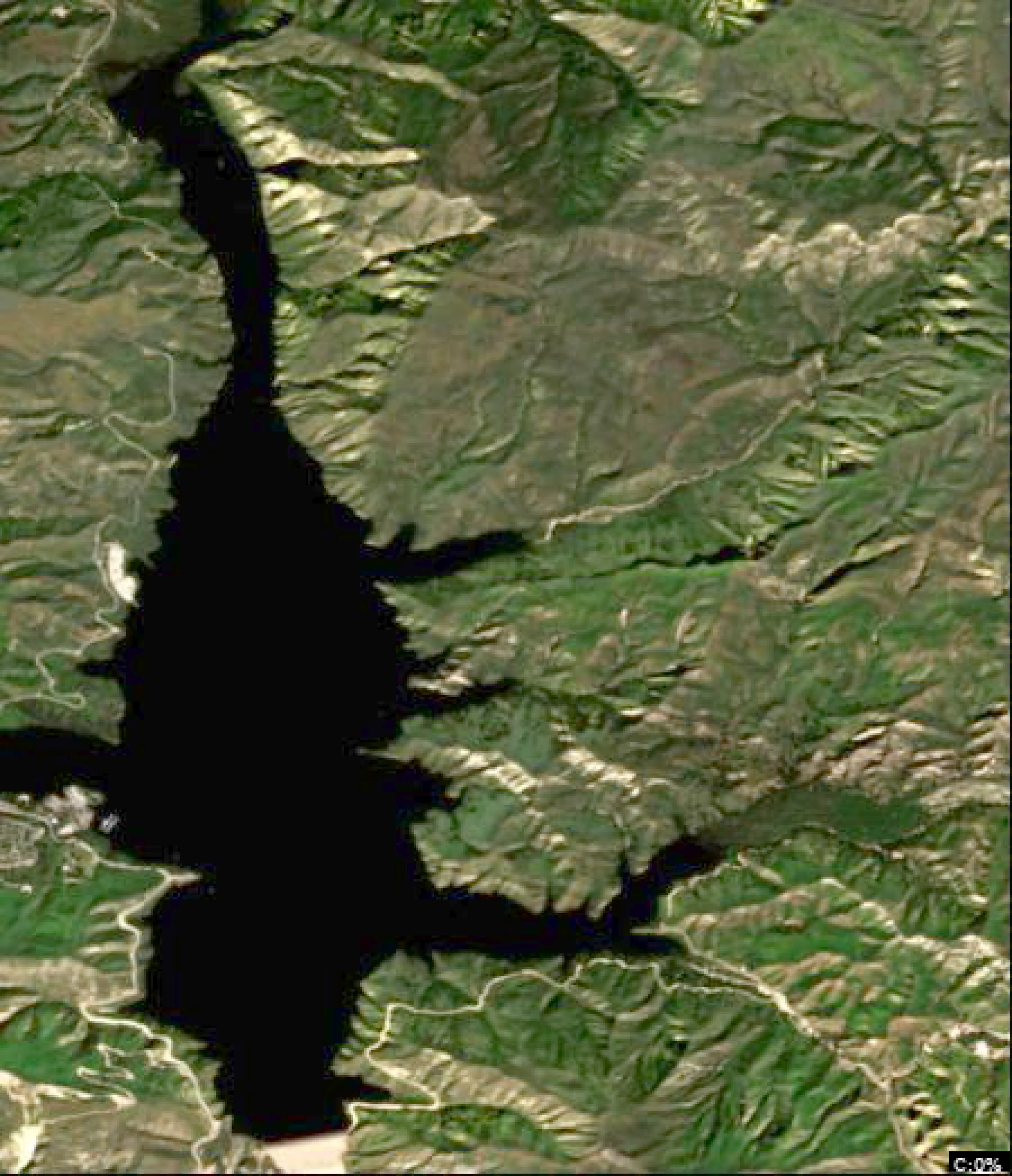
This analysis of Lake Piru is based on the provided satellite imagery, focusing on identifiable structural features that an angler can navigate to on the water.
1. LAKE OVERVIEW
Lake Piru is a canyon-bound reservoir characterized by steep, mountainous terrain.
- Main Lake Body: The southern portion near the dam, which is the widest section of the reservoir.
- Northern Arm: A long, narrow, serpentine channel that stretches north into the canyon.
- Major Landmarks: The Dam (southernmost point), the Marina/Boat Launch area (southwest shore), and the canyon walls that create numerous small, sharp points and pockets throughout the lake.
2. FINDABLE FISHING SPOTS
Spot 1: The Dam Face (Southern Section)
- How to Find It: Head to the extreme southern end of the lake; the dam is the large, light-colored concrete structure.
- What You See: A long, straight concrete wall with deep water immediately adjacent.
- Why Fish It: The dam provides a massive, hard-structure wall that holds heat and attracts baitfish.
- Best Approach: Vertical jigging or parallel casting along the wall for suspended fish.
Spot 2: The Marina Cove (Southwest Shore)
- How to Find It: Locate the boat ramp and marina facilities on the southwest bank.
- What You See: A protected, recessed cove with docks and man-made structures.
- Why Fish It: This is a high-percentage area for pre-spawn bass seeking shelter from wind and access to shallower water.
- Best Approach: Target the edges of the docks and the transition where the cove meets the main lake.
Spot 3: The "Narrows" Point (Mid-Lake, West Shore)
- How to Find It: As you travel north from the marina, look for the first major, sharp point that juts out into the main body on the western bank.
- What You See: A distinct, sharp geological point with a steep drop-off into the main channel.
- Why Fish It: Points are primary migration routes. Fish will stage here before moving into the northern coves.
- Best Approach: Work the point from the deep side toward the shallow tip using crankbaits or jigs.
Spot 4: The Eastern Mid-Lake Pocket
- How to Find It: Directly across from the western narrows, look for the large, deep-reaching cove on the eastern shore.
- What You See: A serpentine, protected bay that branches off the main lake.
- Why Fish It: These pockets offer warmer water and protection from the main lake wind, ideal for staging fish.
- Best Approach: Fan-cast the mouth of the cove, then work the interior banks.
Spot 5: The Northern Canyon Channel
- How to Find It: Travel north past the mid-lake points until the lake narrows significantly into the canyon.
- What You See: A long, dark, narrow channel flanked by steep, high-relief canyon walls.
- Why Fish It: This area acts as a funnel. Any fish moving to the extreme north will pass through this narrow corridor.
- Best Approach: Focus on the "swing" of the channel where the water hits the canyon walls.
3. VISIBLE FEATURES BY SECTION
- Southern Section:
- The Dam: Massive concrete structure; deep water.
- Marina Cove: Docks and boat slips; protected water.
- Main Lake Body:
- Western Points: Sharp, rocky projections extending into the main channel.
- Eastern Coves: Deep, serpentine inlets providing staging areas.
- Northern Section:
- Canyon Channel: Narrow, deep-water corridor; high-relief banks.
4. PRACTICAL FISHING GUIDANCE
- Start (Early Morning): Begin in the Marina Cove or the Eastern Mid-Lake Pockets. These areas warm up faster and provide the best staging cover for pre-spawn fish.
- Mid-Morning/Midday: Move to the Main Lake Points (Western side). As the sun rises, fish will move off the shallow flats and hold on the first available drop-off or point.
- Afternoon: If the wind picks up, retreat to the Northern Canyon Channel. The high walls provide a windbreak, and the narrow channel concentrates fish in a smaller area.
- Navigation: The lake is essentially a "Y" shape with a long northern stem. Always keep the main channel in sight when moving north; the water depth drops off rapidly near the canyon walls. Use the dam as your southern reference point to orient yourself at all times.
Findings:
- This analysis of Lake Piru is based on the provided satellite imagery, focusing on identifiable structural features that an angler can navigate to on the water.
1. LAKE OVERVIEW
Lake Piru is a canyon-bound reservoir characterized by steep, mountainous terrain.
- Main Lake Body: The southern portion near the dam, which is the widest section of the reservoir.
- Northern Arm: A long, narrow, serpentine channel that stretches north into the canyon.
- Major Landmarks: The Dam (southernmost point), the Marina/Boat Launch area (southwest shore), and the canyon walls that create numerous small, sharp points and pockets throughout the lake.
2. FINDABLE FISHING SPOTS
Spot 1: The Dam Face (Southern Section)
- How to Find It: Head to the extreme southern end of the lake; the dam is the large, light-colored concrete structure.
- What You See: A long, straight concrete wall with deep water immediately adjacent.
- Why Fish It: The dam provides a massive, hard-structure wall that holds heat and attracts baitfish.
- Best Approach: Vertical jigging or parallel casting along the wall for suspended fish.
Spot 2: The Marina Cove (Southwest Shore)
- How to Find It: Locate the boat ramp and marina facilities on the southwest bank.
- What You See: A protected, recessed cove with docks and man-made structures.
- Why Fish It: This is a high-percentage area for pre-spawn bass seeking shelter from wind and access to shallower water.
- Best Approach: Target the edges of the docks and the transition where the cove meets the main lake.
Spot 3: The "Narrows" Point (Mid-Lake, West Shore)
- How to Find It: As you travel north from the marina, look for the first major, sharp point that juts out into the main body on the western bank.
- What You See: A distinct, sharp geological point with a steep drop-off into the main channel.
- Why Fish It: Points are primary migration routes. Fish will stage here before moving into the northern coves.
- Best Approach: Work the point from the deep side toward the shallow tip using crankbaits or jigs.
Spot 4: The Eastern Mid-Lake Pocket
- How to Find It: Directly across from the western narrows, look for the large, deep-reaching cove on the eastern shore.
- What You See: A serpentine, protected bay that branches off the main lake.
- Why Fish It: These pockets offer warmer water and protection from the main lake wind, ideal for staging fish.
- Best Approach: Fan-cast the mouth of the cove, then work the interior banks.
Spot 5: The Northern Canyon Channel
- How to Find It: Travel north past the mid-lake points until the lake narrows significantly into the canyon.
- What You See: A long, dark, narrow channel flanked by steep, high-relief canyon walls.
- Why Fish It: This area acts as a funnel. Any fish moving to the extreme north will pass through this narrow corridor.
- Best Approach: Focus on the "swing" of the channel where the water hits the canyon walls.
3. VISIBLE FEATURES BY SECTION
- Southern Section:
- The Dam: Massive concrete structure; deep water.
- Marina Cove: Docks and boat slips; protected water.
- Main Lake Body:
- Western Points: Sharp, rocky projections extending into the main channel.
- Eastern Coves: Deep, serpentine inlets providing staging areas.
- Northern Section:
- Canyon Channel: Narrow, deep-water corridor; high-relief banks.
4. PRACTICAL FISHING GUIDANCE
- Start (Early Morning): Begin in the Marina Cove or the Eastern Mid-Lake Pockets. These areas warm up faster and provide the best staging cover for pre-spawn fish.
- Mid-Morning/Midday: Move to the Main Lake Points (Western side). As the sun rises, fish will move off the shallow flats and hold on the first available drop-off or point.
- Afternoon: If the wind picks up, retreat to the Northern Canyon Channel. The high walls provide a windbreak, and the narrow channel concentrates fish in a smaller area.
- Navigation: The lake is essentially a "Y" shape with a long northern stem. Always keep the main channel in sight when moving north; the water depth drops off rapidly near the canyon walls. Use the dam as your southern reference point to orient yourself at all times.
How this was synthesized
Professional fishing guide analysis integrating 8 tools: analyze_weather_conditions, lure_matrix_wind_clarity, analyze_solunar_timing, analyze_species_behavior, estimate_seasonal_phase, analyze_thermal_patterns, analyze_water_clarity, analyze_satellite_imagery. User request: 'Generate a comprehensive fishing report for Lake Piru. Use tools to analyze satellite structure, thermal patterns, water clarity, weather, and solunar timing, then synthesize a concise plan.'. Synthesis generated comprehensive plan with professional recommendations.