Nimisila Reservoir Fishing Report
Synthesis generated comprehensive plan with professional recommendations.
Nimisila Reservoir Fishing Report
Generated Mar 30, 2026, 6:01 PM.
Key fishing read
- Max thump: giant spinnerbaits, slow roll, contact cover
- Fall: chase baitfish in creeks; spinnerbaits/lipless cranks to cover water
- Estimated phase: fall
- Temp change over window: -36.0°F
- Day 1: High pressure (1018mb) - tougher bite, use finesse tactics
- Day 1: High winds (41mph) - seek protected areas, use heavier lures
- Day 1: Drizzle, High: 67°F, Low: 51°F
- Day 2: High pressure (1013mb) - tougher bite, use finesse tactics
Tool analysis details
Lure Matrix Wind Clarity
Lure guidance for wind=windy, clarity=unknown, phase=fall.
Findings:
- Max thump: giant spinnerbaits, slow roll, contact cover
- Fall: chase baitfish in creeks; spinnerbaits/lipless cranks to cover water
Estimate Seasonal Phase
Season estimate for Nimisila Reservoir: fall.
Findings:
- Estimated phase: fall
- Temp change over window: -36.0°F
Analyze Weather Conditions
Weather analysis for Nimisila Reservoir completed
Findings:
- Day 1: High pressure (1018mb) - tougher bite, use finesse tactics
- Day 1: High winds (41mph) - seek protected areas, use heavier lures
- Day 1: Drizzle, High: 67°F, Low: 51°F
- Day 2: High pressure (1013mb) - tougher bite, use finesse tactics
- Day 2: High winds (57mph) - seek protected areas, use heavier lures
Analyze Solunar Timing
Solunar timing analysis for Nimisila Reservoir completed
Findings:
- 2026-03-30 Major feeding periods: 12:00 AM - 12:00 AM, 12:23 PM - 02:53 PM
- 2026-03-30 Minor feeding periods: 05:05 PM - 06:35 PM, 05:33 AM - 07:03 AM
- 2026-03-31 Major feeding periods: 12:00 AM - 12:00 AM, 01:06 PM - 03:36 PM
- 2026-03-31 Minor feeding periods: 06:11 PM - 07:41 PM, 05:55 AM - 07:25 AM
- 2026-04-01 Major feeding periods: 12:18 AM - 02:48 AM, 01:49 PM - 04:19 PM
Analyze Species Behavior
Species behavior analysis for Nimisila Reservoir completed
Analyze Thermal Patterns
1. Overall Thermal Landscape Summary
- Assumed Orientation: Assuming North is at the top of the image.
- Major Visual Anchors:
- The Northern "Finger": A narrow, elongated section of water extending toward the top of the image.
- The Southern Basin: A wider, more rounded body of water occupying the bottom half of the image.
- The Central Constriction: The narrow area connecting the Northern Finger to the Southern Basin.
- Thermal Summary: The lake is in a state of extreme cold-water conditions. The entire system is dominated by deep navy and dark blue hues, indicating temperatures consistently at or below the 40-46°F (4-8°C) range. The presence of white pixels indicates areas of extreme cold, likely near freezing or representing the lowest thermal threshold of the sensor.
2. Detailed Thermal Feature Analysis
- Temperature Breaks:
- There is a distinct thermal break at the Central Constriction. The water transitions from the slightly "warmer" dark blue (42-46°F / 6-8°C) in the Northern Finger to the significantly colder navy/white (below 40°F / 4°C) in the Southern Basin.
- Pockets/Patches:
- Southern Basin: Contains the coldest water in the image, characterized by white patches (likely 33-39°F / 0.5-4°C). These are concentrated in the center and the eastern edge of the southern basin.
- Northern Finger: This area is more thermally uniform, showing consistent dark blue (42-46°F / 6-8°C) coloring, making it the "warmest" section of the lake.
- Gradients:
- A gradual warming gradient exists moving from the Southern Basin toward the Northern Finger. The transition is most noticeable at the narrow neck connecting the two main bodies.
- Uniform Areas:
- The Northern Finger is the most uniform area, suggesting stable, slow-moving water conditions.
3. Insightful Fish Behavior Interpretation
- Metabolic State: Given the surface temperatures are predominantly in the 33-46°F (0.5-8°C) range, fish metabolism will be at its absolute minimum.
- Behavioral Expectations: Fish will be in a "wintering" mode. They will be highly lethargic, seeking to conserve energy. You should not expect active surface feeding. Fish will likely be holding as close to the bottom as possible, seeking the most stable thermal environment available, which may be slightly warmer than the surface temperatures shown here.
4. Satellite Correlation Analysis
- Inflow/Outflow: The Northern Finger appears to be a potential inflow point. The slightly higher surface temperatures (42-46°F) compared to the rest of the lake suggest this area may be receiving a small amount of groundwater or runoff that is marginally warmer than the stagnant, freezing water in the Southern Basin.
- Wind-Mixing: The lack of complex thermal patterns suggests the lake is currently very stable with little wind-driven mixing, which is typical for water bodies in this temperature range.
5. Actionable Fishing Recommendations
- Target the "Warmest" Water: Focus your efforts in the Northern Finger. While still very cold, the 42-46°F (6-8°C) range is significantly more hospitable than the sub-40°F water in the Southern Basin.
- Slow Down: Use extremely slow, finesse-style presentations. If you are using lures, they should be worked with long pauses.
- Depth is Key: Because the surface is near freezing, do not target the surface. Use the thermal map to identify the "warmest" surface area (the Northern Finger), then target the deepest available water in that specific section.
- Avoid the Southern Basin: The white and navy blue patches in the Southern Basin indicate water that is likely too cold for any significant fish activity. Avoid this area entirely to maximize your efficiency.
- Timing: If you must fish, target the warmest part of the day (mid-afternoon) to see if the surface temperature in the Northern Finger rises slightly, potentially triggering a very brief, minor feeding window.
Findings:
- Current surface temperature: 47.0°F. Fish metabolism significantly reduced in cold water. Target sunny, protected shorelines and use extremely slow presentations. Focus on midday when surface temperatures are warmest.
- Bass spawn timing: Estimated 24 days until pre-spawn staging begins (need ~55°F) (Timing adjusted 15 days later due to elevation 0ft and latitude 45.0°N)
-
1. Overall Thermal Landscape Summary
- Assumed Orientation: Assuming North is at the top of the image.
- Major Visual Anchors:
- The Northern "Finger": A narrow, elongated section of water extending toward the top of the image.
- The Southern Basin: A wider, more rounded body of water occupying the bottom half of the image.
- The Central Constriction: The narrow area connecting the Northern Finger to the Southern Basin.
- Thermal Summary: The lake is in a state of extreme cold-water conditions. The entire system is dominated by deep navy and dark blue hues, indicating temperatures consistently at or below the 40-46°F (4-8°C) range. The presence of white pixels indicates areas of extreme cold, likely near freezing or representing the lowest thermal threshold of the sensor.
2. Detailed Thermal Feature Analysis
- Temperature Breaks:
- There is a distinct thermal break at the Central Constriction. The water transitions from the slightly "warmer" dark blue (42-46°F / 6-8°C) in the Northern Finger to the significantly colder navy/white (below 40°F / 4°C) in the Southern Basin.
- Pockets/Patches:
- Southern Basin: Contains the coldest water in the image, characterized by white patches (likely 33-39°F / 0.5-4°C). These are concentrated in the center and the eastern edge of the southern basin.
- Northern Finger: This area is more thermally uniform, showing consistent dark blue (42-46°F / 6-8°C) coloring, making it the "warmest" section of the lake.
- Gradients:
- A gradual warming gradient exists moving from the Southern Basin toward the Northern Finger. The transition is most noticeable at the narrow neck connecting the two main bodies.
- Uniform Areas:
- The Northern Finger is the most uniform area, suggesting stable, slow-moving water conditions.
3. Insightful Fish Behavior Interpretation
- Metabolic State: Given the surface temperatures are predominantly in the 33-46°F (0.5-8°C) range, fish metabolism will be at its absolute minimum.
- Behavioral Expectations: Fish will be in a "wintering" mode. They will be highly lethargic, seeking to conserve energy. You should not expect active surface feeding. Fish will likely be holding as close to the bottom as possible, seeking the most stable thermal environment available, which may be slightly warmer than the surface temperatures shown here.
4. Satellite Correlation Analysis
- Inflow/Outflow: The Northern Finger appears to be a potential inflow point. The slightly higher surface temperatures (42-46°F) compared to the rest of the lake suggest this area may be receiving a small amount of groundwater or runoff that is marginally warmer than the stagnant, freezing water in the Southern Basin.
- Wind-Mixing: The lack of complex thermal patterns suggests the lake is currently very stable with little wind-driven mixing, which is typical for water bodies in this temperature range.
5. Actionable Fishing Recommendations
- Target the "Warmest" Water: Focus your efforts in the Northern Finger. While still very cold, the 42-46°F (6-8°C) range is significantly more hospitable than the sub-40°F water in the Southern Basin.
- Slow Down: Use extremely slow, finesse-style presentations. If you are using lures, they should be worked with long pauses.
- Depth is Key: Because the surface is near freezing, do not target the surface. Use the thermal map to identify the "warmest" surface area (the Northern Finger), then target the deepest available water in that specific section.
- Avoid the Southern Basin: The white and navy blue patches in the Southern Basin indicate water that is likely too cold for any significant fish activity. Avoid this area entirely to maximize your efficiency.
- Timing: If you must fish, target the warmest part of the day (mid-afternoon) to see if the surface temperature in the Northern Finger rises slightly, potentially triggering a very brief, minor feeding window.
- Spring warming: Focus on shallow bays and areas showing the warmest surface temperatures in thermal imagery as fish move into spawning areas.
Analyze Satellite Imagery
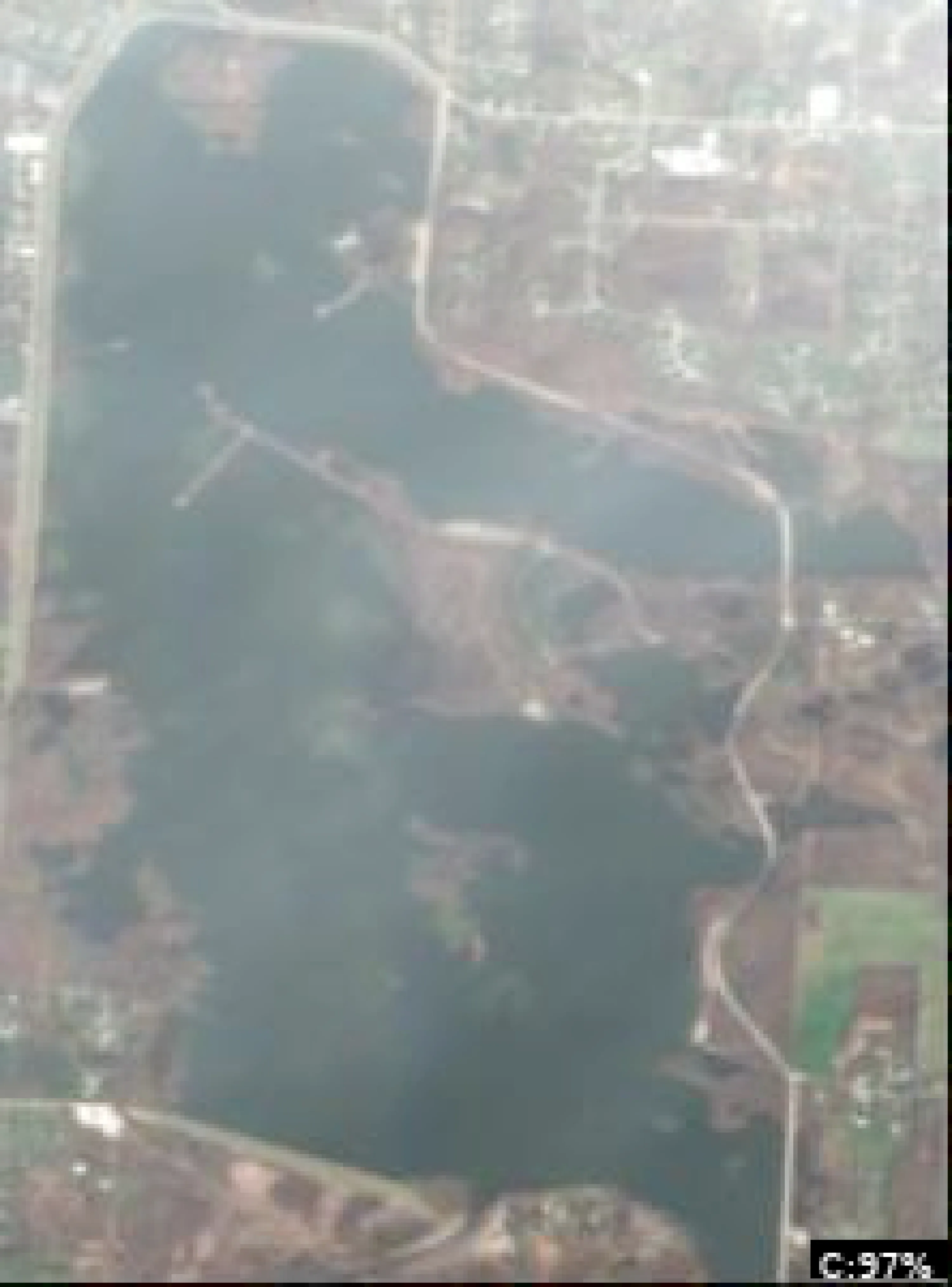
This analysis of Nimisila Reservoir is based on the provided satellite imagery. Given the current water temperature of 47°F, fish are in a pre-spawn/early-spring transition, meaning they will be looking for the first available warming trends near structure.
1. LAKE OVERVIEW
Nimisila Reservoir is characterized by a large, open main basin with a complex, irregular shoreline.
- Main Body: The large, deep-water central area.
- Northern Section: A broad, open area bounded by the northern dam/levee.
- Southern/Eastern Arms: A series of smaller, winding coves and points that offer more protected, shallower water.
- Major Landmarks: The prominent dam/levee running along the northern and western perimeter is the most distinct navigational landmark.
2. FINDABLE FISHING SPOTS
| Spot | General Area | How to Find It | Why Fish It |
|---|---|---|---|
| 1. The Northwest Corner | Northern Section | Follow the western levee north until it turns east. | The intersection of the levee and the shoreline creates a distinct corner that holds heat. |
| 2. The Central Point | Main Lake | Look for the large, prominent point extending into the center of the lake from the eastern shore. | It acts as a primary transition point for fish moving from deep water toward the shallower eastern coves. |
| 3. The Southern Cove Mouths | Southern Section | Navigate to the southern end; look for the narrow openings leading into the smaller, protected bays. | These act as funnels for fish moving into shallower water to feed as the sun warms the surface. |
| 4. The Eastern Shoreline | Eastern Arm | Follow the eastern bank south of the central point; look for the irregular, jagged shoreline. | The irregular geometry provides multiple small pockets and points that break up the current and provide ambush spots. |
| 5. The Southwest Pocket | Western/Southern | Follow the western levee south until it ends near the southern shoreline. | The transition from the man-made levee to the natural shoreline is a high-percentage area for early-season fish. |
3. VISIBLE FEATURES BY SECTION
- Northern Section:
- The Levee Corner: A sharp 90-degree angle where the western and northern levees meet. This is a major structural feature.
- Northern Shoreline: Relatively flat, which will warm up faster than the deep main basin.
- Main Lake Body:
- Central Point: A large, sweeping point on the eastern side that juts out into the main basin.
- Open Water Basin: The deep, dark-colored center of the lake, which serves as the primary thermal refuge for fish in 47°F water.
- Southern/Eastern Sections:
- Cove Entrances: Several distinct "narrows" where the lake opens into smaller, protected bays.
- Irregular Shoreline: The eastern bank is highly textured with small points and indentations, providing excellent cover.
4. PRACTICAL FISHING GUIDANCE
Fishing Progression:
- Start (Early Morning): Focus on the Central Point and the Eastern Shoreline. In 47°F water, fish will be holding near the first drop-offs they can find. These points allow them to move from deep water to shallow flats quickly.
- Mid-Morning/Afternoon: Move to the Southern Cove Mouths. As the sun hits the water, these shallower, protected areas will warm up faster than the main lake. Fish will move into these areas to feed.
- Pattern: Think of the lake as a series of "highways." The main lake basin is the highway; the points and creek mouths are the exit ramps. Fish the "exit ramps" (points and cove mouths) where they intersect with the main basin.
Navigation:
- Use the Western Levee as your primary navigational reference. It is a straight, clear line that helps you orient yourself regardless of which part of the lake you are in.
- When moving from the Northern section to the Southern section, stay in the center of the main basin to avoid shallow, unmarked structure near the points.
Priority Target Ranking (Average): 7/10
- Reasoning: The reservoir has excellent structural diversity (points, levee corners, and coves). The primary challenge is the 47°F water temperature, which will keep fish lethargic and tight to the bottom structure. Focus on slow, methodical presentations near the points identified above.
Findings:
- This analysis of Nimisila Reservoir is based on the provided satellite imagery. Given the current water temperature of 47°F, fish are in a pre-spawn/early-spring transition, meaning they will be looking for the first available warming trends near structure.
1. LAKE OVERVIEW
Nimisila Reservoir is characterized by a large, open main basin with a complex, irregular shoreline.
- Main Body: The large, deep-water central area.
- Northern Section: A broad, open area bounded by the northern dam/levee.
- Southern/Eastern Arms: A series of smaller, winding coves and points that offer more protected, shallower water.
- Major Landmarks: The prominent dam/levee running along the northern and western perimeter is the most distinct navigational landmark.
2. FINDABLE FISHING SPOTS
| Spot | General Area | How to Find It | Why Fish It |
|---|---|---|---|
| 1. The Northwest Corner | Northern Section | Follow the western levee north until it turns east. | The intersection of the levee and the shoreline creates a distinct corner that holds heat. |
| 2. The Central Point | Main Lake | Look for the large, prominent point extending into the center of the lake from the eastern shore. | It acts as a primary transition point for fish moving from deep water toward the shallower eastern coves. |
| 3. The Southern Cove Mouths | Southern Section | Navigate to the southern end; look for the narrow openings leading into the smaller, protected bays. | These act as funnels for fish moving into shallower water to feed as the sun warms the surface. |
| 4. The Eastern Shoreline | Eastern Arm | Follow the eastern bank south of the central point; look for the irregular, jagged shoreline. | The irregular geometry provides multiple small pockets and points that break up the current and provide ambush spots. |
| 5. The Southwest Pocket | Western/Southern | Follow the western levee south until it ends near the southern shoreline. | The transition from the man-made levee to the natural shoreline is a high-percentage area for early-season fish. |
3. VISIBLE FEATURES BY SECTION
- Northern Section:
- The Levee Corner: A sharp 90-degree angle where the western and northern levees meet. This is a major structural feature.
- Northern Shoreline: Relatively flat, which will warm up faster than the deep main basin.
- Main Lake Body:
- Central Point: A large, sweeping point on the eastern side that juts out into the main basin.
- Open Water Basin: The deep, dark-colored center of the lake, which serves as the primary thermal refuge for fish in 47°F water.
- Southern/Eastern Sections:
- Cove Entrances: Several distinct "narrows" where the lake opens into smaller, protected bays.
- Irregular Shoreline: The eastern bank is highly textured with small points and indentations, providing excellent cover.
4. PRACTICAL FISHING GUIDANCE
Fishing Progression:
- Start (Early Morning): Focus on the Central Point and the Eastern Shoreline. In 47°F water, fish will be holding near the first drop-offs they can find. These points allow them to move from deep water to shallow flats quickly.
- Mid-Morning/Afternoon: Move to the Southern Cove Mouths. As the sun hits the water, these shallower, protected areas will warm up faster than the main lake. Fish will move into these areas to feed.
- Pattern: Think of the lake as a series of "highways." The main lake basin is the highway; the points and creek mouths are the exit ramps. Fish the "exit ramps" (points and cove mouths) where they intersect with the main basin.
Navigation:
- Use the Western Levee as your primary navigational reference. It is a straight, clear line that helps you orient yourself regardless of which part of the lake you are in.
- When moving from the Northern section to the Southern section, stay in the center of the main basin to avoid shallow, unmarked structure near the points.
Priority Target Ranking (Average): 7/10
- Reasoning: The reservoir has excellent structural diversity (points, levee corners, and coves). The primary challenge is the 47°F water temperature, which will keep fish lethargic and tight to the bottom structure. Focus on slow, methodical presentations near the points identified above.
Analyze Water Clarity
This analysis of Nimisila Reservoir is based on the provided satellite imagery, which indicates a highly uniform water quality profile across the main basin.
1. Overall Water Quality Summary
The imagery reveals a dominant "Bottom Left" (Dark Blue/Teal) condition across the entirety of the reservoir. This indicates a system currently characterized by Low Sediment and Low Chlorophyll. The water is exceptionally clear, with visibility likely in the 15–25+ foot range. There are no significant plumes of sediment or algae blooms visible, suggesting a stable, high-clarity environment throughout the main body of the lake.
2. Detailed Clarity Zone Mapping & Characterization
- Primary Zone (Entire Basin):
- Matrix Position: Bottom-Left (Dark Blue/Teal).
- Combined Conditions: Low sediment + Low chlorophyll.
- Visibility: 15–25+ feet.
- Tactical Implications: This is a "sight-fishing" environment. Fish will be highly sensitive to boat pressure, noise, and unnatural lure profiles. Stealth is the primary requirement for success.
3. Turbidity/Algae Sources & Transition Zones
- Source Identification: There are no visible "hotspots" of turbidity or nutrient-rich inflows (which would appear as Tan or Red/Yellow). The reservoir appears to be in a state of high-clarity equilibrium.
- Transition Zones: Because the water quality is uniform, there are no "mudlines" or "algae edges" to target. Anglers should focus on structural transitions (depth changes, points, or submerged vegetation) rather than water quality transitions.
4. Species-Specific Clarity Strategy
- Bass: With such high visibility, bass will likely be holding deeper or tighter to heavy cover to ambush prey. Target the deepest available structure or the shaded sides of docks and timber.
- Walleye/Crappie: These species may be pushed deeper than usual to find comfort in the low-light zones, as the high clarity allows light to penetrate deep into the water column. Focus on the bottom-contour breaks.
- General Approach: Since the water is uniformly clear, fish will be able to see lures from a great distance. Use this to your advantage by covering water with long-casting search baits, but keep the profile natural.
5. Tactical Fishing Adjustments
- Lure Selection:
- Colors: Stick to "match-the-hatch" natural colors: Green Pumpkin, Watermelon Seed, Smoke, or clear/shad patterns. Avoid bright chartreuse or loud, opaque colors.
- Profiles: Use finesse baits—Ned rigs, drop shots, and small, subtle swimbaits.
- Presentation:
- Stealth: Use fluorocarbon line (8–10lb test) to minimize visibility.
- Casting: Make long, accurate casts. Avoid running the trolling motor on high settings; use it sparingly to maintain position.
- Retrieval: Slow, natural retrieves are preferred. If the fish are sluggish (47°F water temp), a "dead-sticking" approach with a soft plastic will be more effective than a fast-moving reaction bait.
6. Seasonal Context
The uniform, high-clarity (Dark Blue/Teal) imagery is consistent with early spring or late fall conditions in a reservoir. The lack of chlorophyll (algae) suggests the water temperature is likely too cool for significant biological growth, which aligns with the reported 47°F water temperature. The reservoir is currently in a "clear-water reset" phase, where the lack of suspended solids makes the fish highly susceptible to spooking. Focus on slow, methodical presentations in the deepest, most stable water available.
Findings:
- This analysis of Nimisila Reservoir is based on the provided satellite imagery, which indicates a highly uniform water quality profile across the main basin.
1. Overall Water Quality Summary
The imagery reveals a dominant "Bottom Left" (Dark Blue/Teal) condition across the entirety of the reservoir. This indicates a system currently characterized by Low Sediment and Low Chlorophyll. The water is exceptionally clear, with visibility likely in the 15–25+ foot range. There are no significant plumes of sediment or algae blooms visible, suggesting a stable, high-clarity environment throughout the main body of the lake.
2. Detailed Clarity Zone Mapping & Characterization
- Primary Zone (Entire Basin):
- Matrix Position: Bottom-Left (Dark Blue/Teal).
- Combined Conditions: Low sediment + Low chlorophyll.
- Visibility: 15–25+ feet.
- Tactical Implications: This is a "sight-fishing" environment. Fish will be highly sensitive to boat pressure, noise, and unnatural lure profiles. Stealth is the primary requirement for success.
3. Turbidity/Algae Sources & Transition Zones
- Source Identification: There are no visible "hotspots" of turbidity or nutrient-rich inflows (which would appear as Tan or Red/Yellow). The reservoir appears to be in a state of high-clarity equilibrium.
- Transition Zones: Because the water quality is uniform, there are no "mudlines" or "algae edges" to target. Anglers should focus on structural transitions (depth changes, points, or submerged vegetation) rather than water quality transitions.
4. Species-Specific Clarity Strategy
- Bass: With such high visibility, bass will likely be holding deeper or tighter to heavy cover to ambush prey. Target the deepest available structure or the shaded sides of docks and timber.
- Walleye/Crappie: These species may be pushed deeper than usual to find comfort in the low-light zones, as the high clarity allows light to penetrate deep into the water column. Focus on the bottom-contour breaks.
- General Approach: Since the water is uniformly clear, fish will be able to see lures from a great distance. Use this to your advantage by covering water with long-casting search baits, but keep the profile natural.
5. Tactical Fishing Adjustments
- Lure Selection:
- Colors: Stick to "match-the-hatch" natural colors: Green Pumpkin, Watermelon Seed, Smoke, or clear/shad patterns. Avoid bright chartreuse or loud, opaque colors.
- Profiles: Use finesse baits—Ned rigs, drop shots, and small, subtle swimbaits.
- Presentation:
- Stealth: Use fluorocarbon line (8–10lb test) to minimize visibility.
- Casting: Make long, accurate casts. Avoid running the trolling motor on high settings; use it sparingly to maintain position.
- Retrieval: Slow, natural retrieves are preferred. If the fish are sluggish (47°F water temp), a "dead-sticking" approach with a soft plastic will be more effective than a fast-moving reaction bait.
6. Seasonal Context
The uniform, high-clarity (Dark Blue/Teal) imagery is consistent with early spring or late fall conditions in a reservoir. The lack of chlorophyll (algae) suggests the water temperature is likely too cool for significant biological growth, which aligns with the reported 47°F water temperature. The reservoir is currently in a "clear-water reset" phase, where the lack of suspended solids makes the fish highly susceptible to spooking. Focus on slow, methodical presentations in the deepest, most stable water available.
How this was synthesized
Professional fishing guide analysis integrating 8 tools: lure_matrix_wind_clarity, estimate_seasonal_phase, analyze_weather_conditions, analyze_solunar_timing, analyze_species_behavior, analyze_thermal_patterns, analyze_satellite_imagery, analyze_water_clarity. User request: 'Generate a comprehensive fishing report for Nimisila Reservoir. Use tools to analyze satellite structure, thermal patterns, water clarity, weather, and solunar timing, then synthesize a concise plan.'. Synthesis generated comprehensive plan with professional recommendations.