The 1-10-1 Rule: What Cold Water Does to Your Body in the First Hour
When a late-fall boater goes overboard, hypothermia is rarely what kills them. Here's what cold water does to the body minute by minute, and how anglers and duck hunters can get through it.
By LakeMonster News6 min read
Just before 7 a.m. on November 14, a 19-year-old duck hunter paddled out to pick up a bird he had shot on Kincaid Lake in central Louisiana. His kayak got hung up on a stump. While he was working it free, the kayak flipped. He was not wearing a life jacket, and the people hunting with him saw it happen but couldn't reach him. KALB reported that the air was about 40 degrees.
When Louisiana Department of Wildlife and Fisheries agents got there, he was hanging onto the stump with about half his body out of the water, worn out and shaking hard. He had been in the water about 20 minutes. He was treated for hypothermia and went home that day.
He was lucky. His story also shows that cold water hits the body in stages, and each stage brings its own way to die. Once you know the order, the things that keep you alive start to make sense.
The first minute: cold shock
Most people think of cold water as a hypothermia problem: you slowly chill until you pass out. But the danger starts the moment your skin hits the water. A 2026 review in the Journal of Applied Physiology says the data challenge the common belief that hypothermia is the main killer. Instead, it points to fast reactions that happen before your core temperature even begins to drop.
The first of these is cold shock. The National Center for Cold Water Safety describes a huge, involuntary gasp that fills your lungs, often several in a row. If your head is underwater when that happens, you drown right there. Next comes hyperventilation, with breathing as fast as 65 breaths a minute. At that rate you can't time swim strokes to your breaths, and even good swimmers often can't make 6 to 10 feet (2 to 3 m).
You also lose the ability to hold your breath. In one study of volunteers in 41°F (5°C) water, the average breath-hold dropped from 45 seconds to 9.5. A scary feeling of suffocation can last up to three minutes, which makes panic more likely. Meanwhile, the blood vessels in your skin clamp down, so heart rate and blood pressure jump. In people with heart problems, that raises the risk of heart failure or stroke.
The part worth repeating at the boat ramp: you don't need ice on the lake for this. According to the same center, most people who aren't used to cold water hit their strongest cold shock somewhere between 50 and 60°F (10 to 15°C). Cold shock is as bad in that range as it is at 35°F (2°C). Colder water hurts more and makes clear thinking harder, but once you've lost control of your breathing, you can't lose it any further. Plenty of lakes in the southern half of the country sit right in that range in late November.
The next ten minutes: when your arms quit
If you get through the gasping, the next threat is your muscles. Cold water pulls heat out of your arms and legs long before your core gets cold. The Journal of Applied Physiology review calls this swimming failure: the nerves and muscles in your limbs cool off and stop working well, even though your core temperature is still close to normal.
This is where the 1-10-1 rule comes from. Gordon Giesbrecht, a thermophysiologist who has spent his career running cold-water experiments on volunteers, came up with it to help people survive going overboard. As McGill University's Office for Science and Society explains it:
- 1 minute: cold shock. Your job is to stay calm and get your breathing under control.
- 10 minutes: cold incapacitation. This is roughly how long you can still make useful movements before your muscles stop working.
- 1 hour: hypothermia. It takes about this long to make you unconscious.
The numbers are rough guides, not timers. Body size, fat, clothing and how rough the water is all shift them. But the order matters. You spend the first minute breathing, not swimming. You spend the next ten minutes getting out or getting as much of your body out of the water as you can, while your hands still work.
The hour, and the moment of rescue
Hypothermia does come eventually. Giesbrecht notes it takes at least half an hour to set in, and that most people who die in cold water die right away or soon after going in. The physiology review adds that in most cold-water drowning deaths, the body cools only after the person has already inhaled water and stopped breathing. In those cases hypothermia comes after death rather than causing it.
The review adds a fourth stage that many boaters have never heard of: circum-rescue collapse. A badly chilled person can collapse just before, during or soon after being pulled out of the water. The main cause is the sudden loss of water pressure on the body when it leaves the water. That's why the authors strongly recommend lifting victims out horizontally and avoiding long vertical lifts.
What this means for a day on the water
Late fall puts more people in small boats on cold water than any other time: duck hunters, muskie and walleye anglers, people pulling docks and lifts. A few habits line up with each stage.
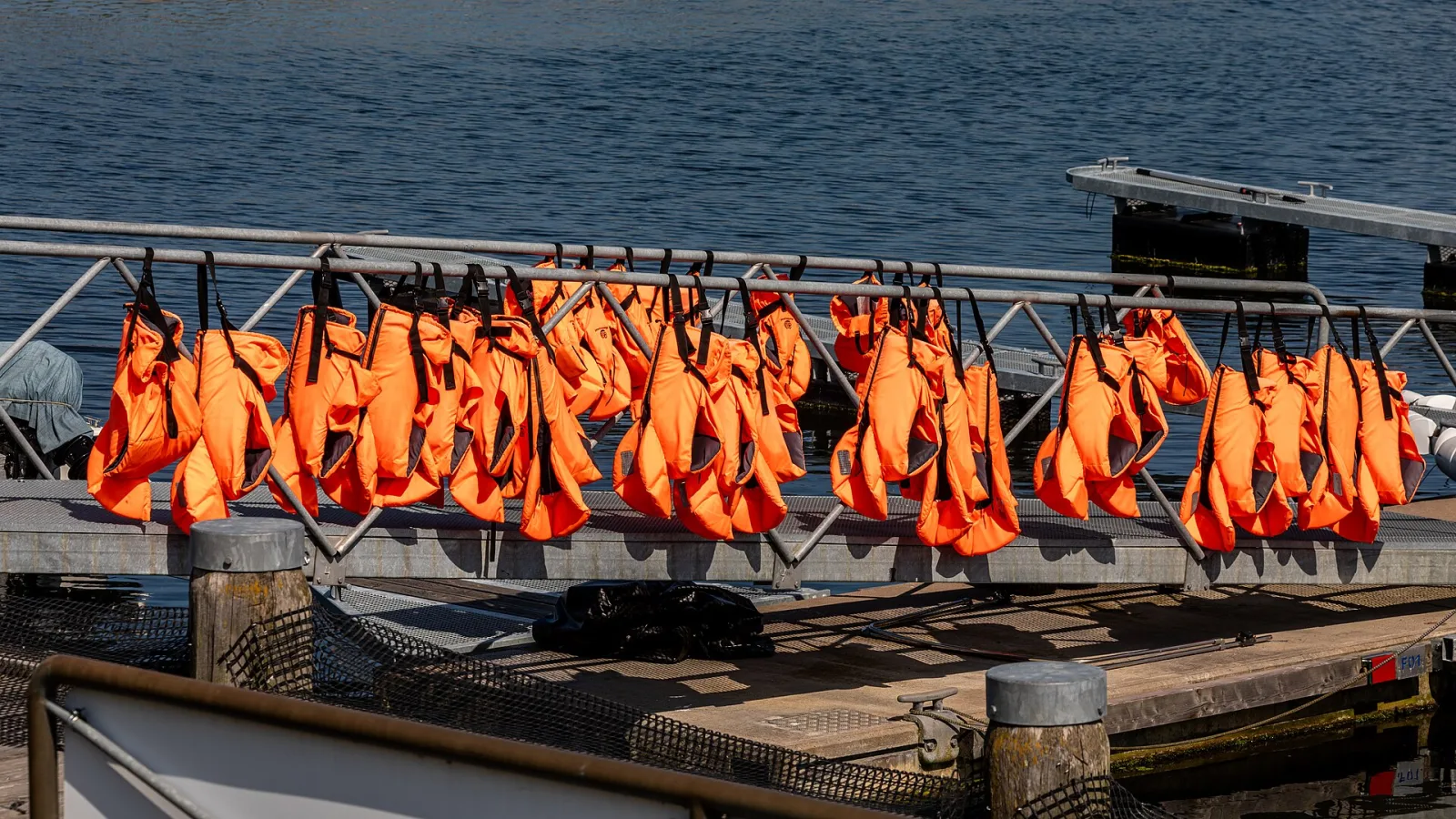
Wear the life jacket, don't just carry it. A life jacket is the only thing that keeps your head up during the gasping minute, when you can't control your breathing and can't swim. You won't have time to find one and put it on after you go in. Heavy waterfowl clothing makes this even more important.
Check the water temperature, not the air. Before you launch, look at the water temperature for your lake on LakeMonster. If it reads in the 50s or lower, a full-strength cold shock is possible. Dress as if you might go in.
If you go in, float first. Tilt your head back, keep your face clear and focus on slowing your breathing for that first minute. Don't try to swim for a far shore.
Use your ten minutes on the boat. Climb back in, crawl onto the hull, or pull yourself onto anything that floats, like the Kincaid Lake hunter did with his stump. The National Weather Service, passing along Coast Guard advice, says to get as much of your body out of the water as you can.
If you can't get out, hold your heat. Get into the Heat Escape Lessening Position (H.E.L.P.): knees pulled to your chin, legs together, arms pressed to your sides, head out of the water. If others are in the water with you, huddle together.
When you pull someone out, keep them flat. Lift them as horizontally as you can, handle them gently, call 911 and get medical help, even if they seem fine.
The hunter on Kincaid Lake made it through all of these stages without a life jacket. Most people's odds are much better with one on.
Questions and answers
- If I'm a strong swimmer, can I just swim to shore?
- Probably not in cold water. Cold shock causes gasping and breathing as fast as 65 breaths a minute, and many good swimmers can't manage even 6 to 10 feet in that state. After that, your arm muscles cool and weaken. Unless shore is very close, it's usually safer to float, get your breathing back and climb onto the boat or anything that floats.
- At what water temperature should I start worrying about cold shock?
- The National Center for Cold Water Safety says most people who aren't used to cold water have their strongest cold shock between 50 and 60°F (10 to 15°C). That's just as intense as near-freezing water. Water colder than that adds pain and makes it harder to think, but the danger begins well above freezing.
- Why are rescuers told to lift a cold victim out horizontally?
- A badly chilled person can collapse just before, during or right after rescue. This is called circum-rescue collapse. A 2026 physiology review links it mainly to the sudden loss of water pressure on the body when it comes out of the water, and recommends lifting horizontally rather than hoisting the person upright for a long time.
Sources
- 19-year-old duck hunter rescued after kayak capsizes on Kincaid Lake, KALB News (read Nov 25, 2026)
- Stage 1 - Cold Shock, National Center for Cold Water Safety (read Nov 25, 2026)
- What is Cold Water?, National Center for Cold Water Safety (read Nov 25, 2026)
- Professor Popsicle's Physiological Proof, McGill University Office for Science and Society (read Nov 25, 2026)
- Beyond hypothermia: mechanisms of death, rescue, and prevention in cold water immersion - a narrative review, Journal of Applied Physiology (American Physiological Society) (read Nov 25, 2026)
- Cold Water Hazards and Safety, National Weather Service (read Nov 25, 2026)
Photo credits
- Dietmar Rabich, via Wikimedia Commons · CC BY-SA 4.0 · source