Maryland Schools Put Invasive Blue Catfish on the Lunch Menu
Montgomery County Public Schools has put Chesapeake blue catfish on cafeteria menus, joining other Maryland districts that are turning an invasive Bay predator into lunch. The state asks anglers to keep and kill blue catfish, and it is illegal to move a live one to another body of water.
By LakeMonster News5 min read

One way to fight an invasive fish is to put it on a cafeteria tray.
Montgomery County Public Schools, Maryland's largest district, announced on October 8 that its Department of Food and Nutrition Services had started serving Chesapeake blue catfish in schools this year. At a kickoff with Maryland Agriculture Secretary Kevin Atticks and students at Dr. Martin Luther King, Jr. Middle School, elementary menus featured a catfish cake with pineapple salsa, and secondary schools got a catfish-cake sandwich on a whole-grain bun.
The district's own explanation was conservation as much as lunch. "Removing more blue catfish from the Bay is an important part of managing their ecological impact — and creating a strong market for this locally caught fish gives Maryland watermen an economic incentive to harvest more of them," the school system wrote.
That idea has been spreading across the Chesapeake Bay watershed for years. On September 26, 2019, the Maryland Department of Agriculture held its Homegrown School Lunch Week kickoff at Denton Elementary School in Caroline County, and the official lunch included blue catfish tacos supplied by Chester River Clam Company. Caroline County schools have continued to serve the fish, including more recently as catfish cakes through Real Good Fish's Bay2Tray program; local television covered that work earlier in 2026. In late October and early November, the school-lunch story also circulated widely in national and social coverage as a concrete way to eat an invader.
Why the Bay has a blue catfish problem
Blue catfish (Ictalurus furcatus) are native to the Mississippi, Missouri, and Ohio river basins. They are not native to the Chesapeake. The U.S. Fish and Wildlife Service and the Maryland Department of Natural Resources both say the fish were introduced to Virginia rivers in the 1970s and 1980s to improve recreational fishing. A 2024 Maryland DNR feature said the Virginia Department of Game and Inland Fisheries (now the Department of Wildlife Resources) released more than 300,000 juvenile blue catfish from 1974 to 1985, first in the James and Rappahannock rivers and later in the York.
Managers once expected the Bay's salt water to keep a freshwater fish from spreading. It did not. Maryland DNR says blue catfish can tolerate salinities up to 17 parts per thousand for short periods and have thrived in the Bay's brackish tributaries. They can live more than 20 years and grow to more than five feet and more than 100 pounds; Maryland's state record is 84 pounds. They eat blue crabs, clams, American shad, American eels, and white perch, and large fish feed mostly on other fish. In the past 20 years, the department says, they have spread into all major tidal rivers in Maryland's portion of the Bay and into the upper Bay. They were first documented in the Patuxent River in the 2000s; recent work there estimated more than 75,000 fish eight inches or longer in a five-mile stretch, with densities of 1,250 such fish per acre in some sections. Commercial harvesters removed 4.2 million pounds from the Potomac and Maryland in 2023.
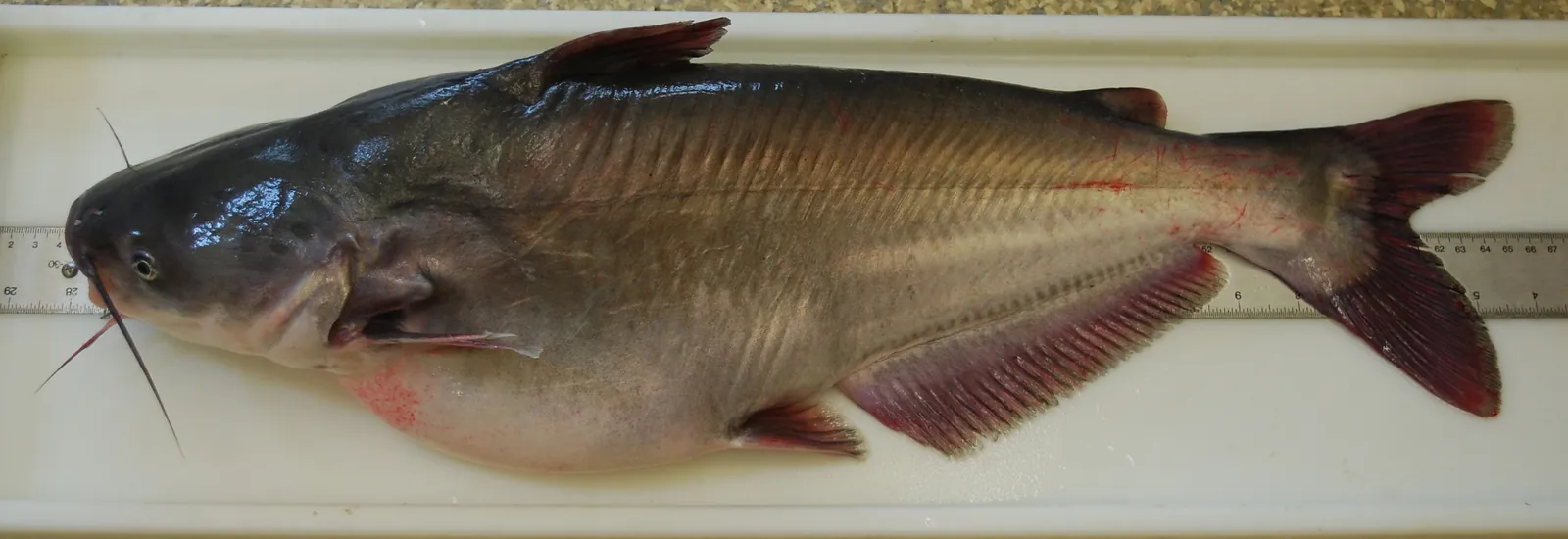 Photo: Smithsonian Environmental Research Center · CC BY 2.0
A 600-millimeter (about 24-inch) blue catfish (Ictalurus furcatus) collected at the mouth of the Rhode River, Anne Arundel County, Maryland, on June 7, 2019. The species is invasive in the Chesapeake. Photo: Smithsonian Environmental Research Center, CC BY 2.0.
Some advocates have used very large figures for the share of the Bay's biomass made up by blue catfish. We did not find a bay-wide biomass estimate in the federal and state sources we checked, so we are not repeating those percentages here. The documented densities, the diet, and the spread into every major Maryland tidal river are already enough to explain why the state wants the fish removed.
The official advice to anglers is not catch-and-release
Maryland DNR's guidance is unusually blunt for a popular game fish. "The department asks anglers to remove and kill any blue and flathead catfish they catch," its blue catfish page says. "Catch and release of these fish is discouraged," because they threaten the watershed. It is illegal in Maryland to transport live blue or flathead catfish into another body of water, with fines of up to $2,500. The department also points anglers to its Invasive Species Tracker and Angler's Log to report catches.
A school kitchen does not replace that advice, but it supports the same goal: a market that makes it worth someone's time to take blue catfish out of the system and not put them back. Montgomery County's rollout is one of the more visible recent examples, because it puts a Chesapeake problem on trays in the state's largest public school district and ties the menu to watermen who harvest the fish.
If you fish the Bay or its tidal rivers, the state's request is straightforward: learn to identify a blue catfish—deeply forked tail, straight-edged anal fin with 30 to 35 rays, silvery-blue to slate gray with a white underside—and do not move a live one to a new lake or river. If you are looking at a school menu in Maryland this fall, the catfish sandwich is not a novelty protein so much as a small, edible piece of an invasive-species problem that started with a 1970s stocking and has not stayed in Virginia.
Questions and answers
- Why are Maryland schools serving blue catfish?
- Montgomery County Public Schools said serving locally caught Chesapeake blue catfish helps create a market that gives watermen a reason to harvest more of an invasive species that preys on crabs and native fish. Other districts, including Caroline County, have also put the fish on lunch menus.
- Are blue catfish native to Chesapeake Bay?
- No. They are native to the Mississippi, Missouri, and Ohio river basins. Maryland DNR and the U.S. Fish and Wildlife Service say they were introduced to Virginia rivers in the 1970s and 1980s for recreational fishing and later spread throughout the Bay's tidal rivers.
- Should I release a blue catfish if I catch one in Maryland?
- Maryland DNR asks anglers to remove and kill blue and flathead catfish they catch and discourages catch-and-release. It is illegal in Maryland to transport live blue or flathead catfish into another body of water, with fines of up to $2,500.
- How big do they get, and what do they eat?
- Maryland DNR says blue catfish can live more than 20 years and grow to more than five feet and more than 100 pounds; the Maryland state record is 84 pounds. They eat blue crabs, clams, shad, eels, and white perch, and large individuals feed mostly on other fish.
The lake in this story
Sources
- From the Chesapeake Bay to Your Cafeteria Tray, Montgomery County Public Schools (read Nov 22, 2026)
- Blue Catfish (biology, concerns, mitigation, and angler guidance), Maryland Department of Natural Resources (read Nov 22, 2026)
- Blue Catfish Are Spreading Rapidly in Maryland Waters, as State Officials and the Fishing Community Work To Contain the Invasive Species, Maryland Department of Natural Resources (read Nov 22, 2026)
- State, Local Leaders Kick Off 12th Annual Maryland Homegrown School Lunch Week at Denton Elementary School in Caroline County, Maryland Department of Agriculture (archived press release) (read Nov 22, 2026)
- A Blue catfish, now invasive in Chesapeake Bay, U.S. Fish and Wildlife Service (read Nov 22, 2026)
- From bay to tray; Caroline County Schools serve up catfish at lunch, WBOC (read Nov 22, 2026)