Fall Turnover: Why Your Lake Flips at 39°F Before It Can Freeze
Fresh water is heaviest at 39.2°F, and that quirk makes lakes flip every fall before they can freeze. Here is how turnover works and what it means for fishing now.
By LakeMonster News6 min read
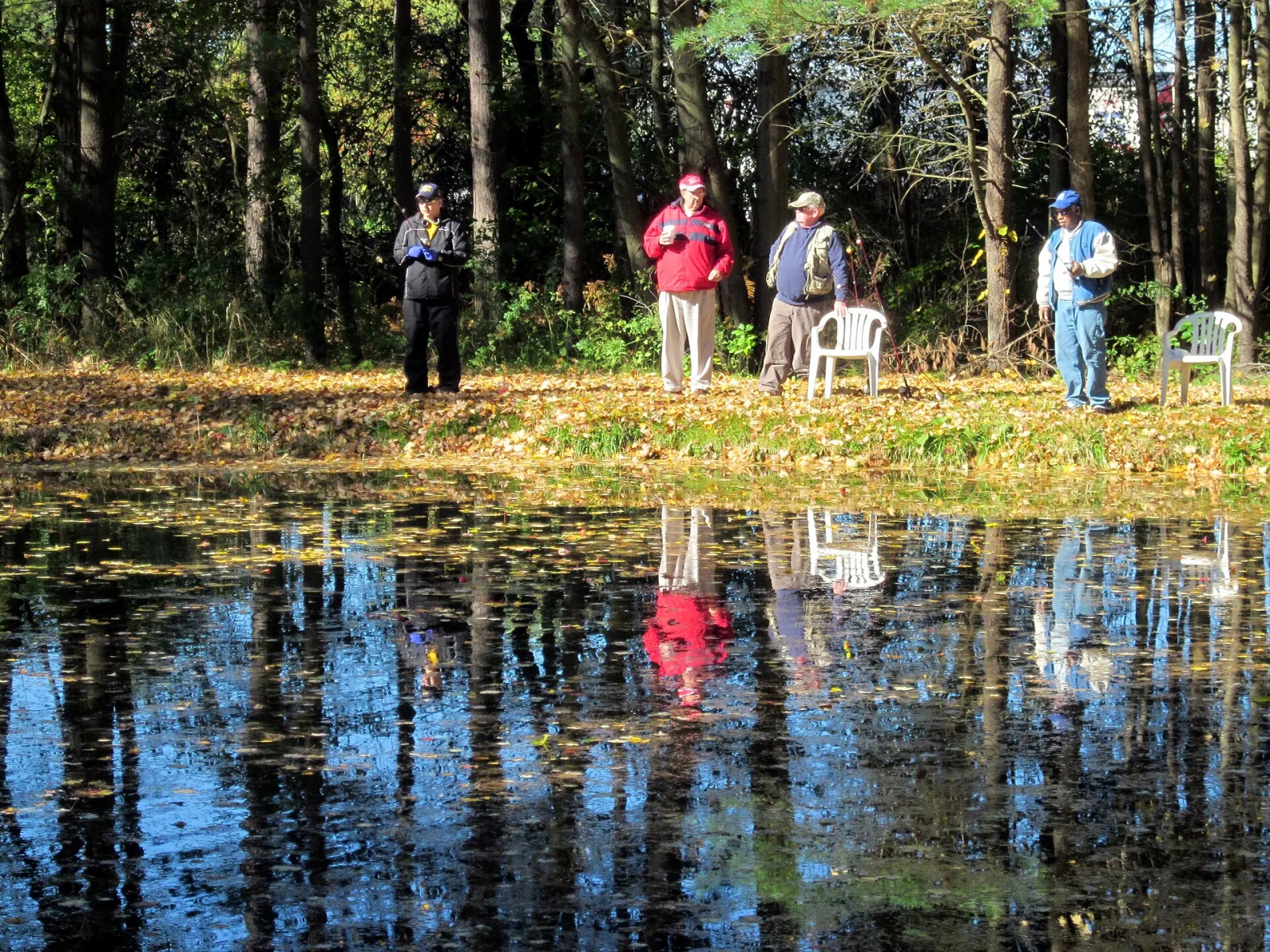
Every fall, somewhere between the last warm weekend and first ice, many lakes quietly turn themselves inside out. Water that has sat on the bottom since late spring, dark and short of oxygen, mixes back up to the surface.
Anglers call it turnover, and they blame it for murky water, a sulfur smell and fish that seem to vanish. The cause is an odd habit of water itself, and the same habit decides when your lake can freeze.
Water is heaviest just above freezing
Most liquids get denser as they cool, right down to the point where they turn solid. Fresh water breaks that rule. The U.S. Geological Survey puts its maximum density at 39.2°F (4°C), when a milliliter weighs just under one gram: 0.9998395 grams.
Below 39.2°F, water gets lighter again, and ice is lighter still, which is why it floats. The USGS points out that if water were densest at its freezing point, the coldest water would sink in winter and lakes could freeze from the bottom up.
That one number runs a lake's whole year. Water on the Web, a lake-science program from the University of Minnesota Duluth, describes the typical cycle of a temperate lake in four stages:
- Spring turnover. After ice-out the surface warms to match the bottom water, and wind mixes the lake top to bottom.
- Summer stratification. The surface keeps warming until it is too light to mix with the cold water below, and the lake splits into layers.
- Fall turnover. The surface cools until it matches the bottom again, and the whole lake mixes.
- Winter stratification. Under the ice, water near 32°F (0°C) sits on top of water near 39°F (4°C) at the bottom.
Lakes that mix twice a year like this are called dimictic.
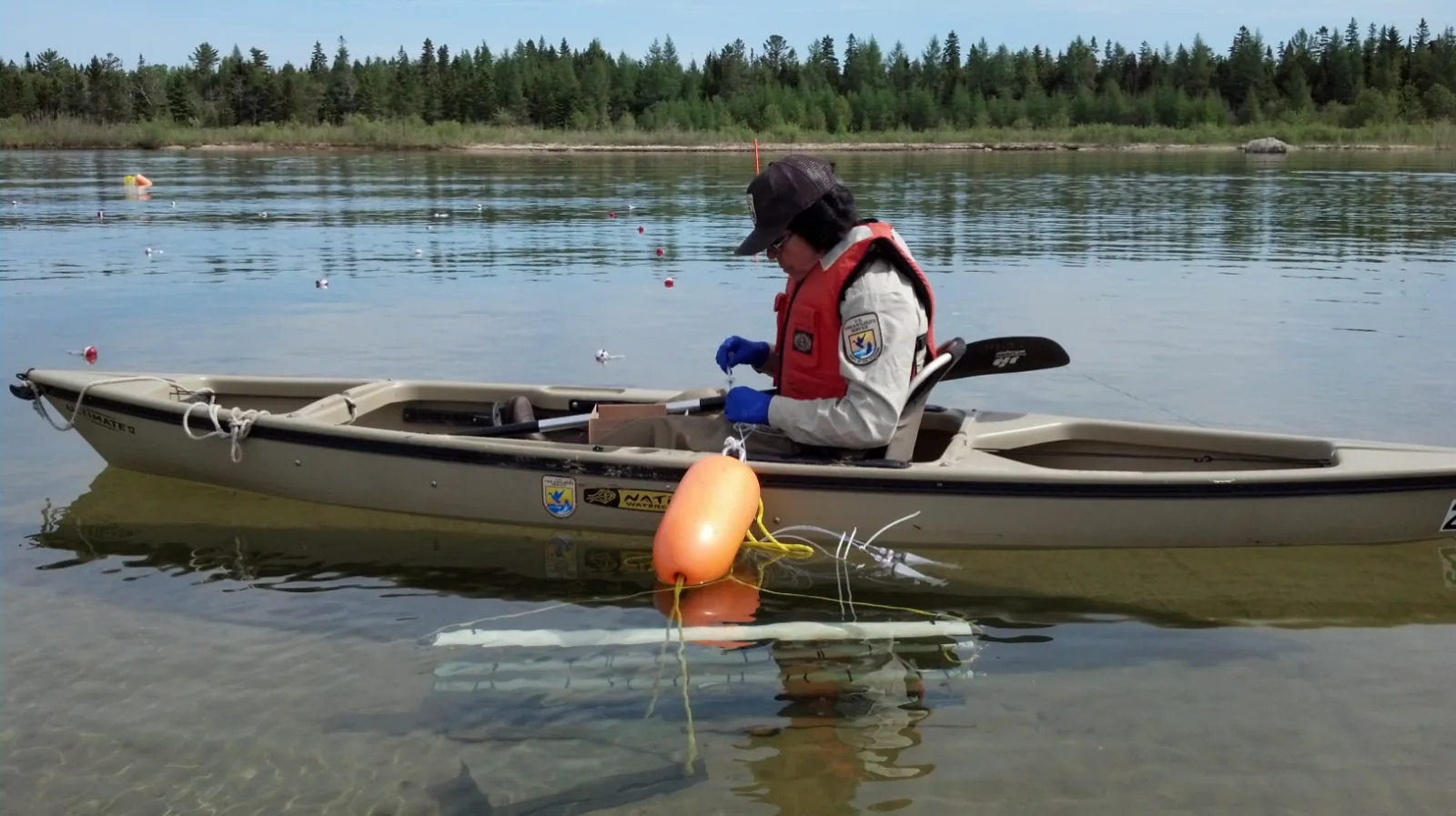 A biologist takes water samples from a kayak at Hog Island Creek, Michigan. Photo: Cheryl Kaye/USFWS, via Wikimedia Commons · Public domain
Summer layers and the hidden oxygen problem
A stratified lake has three layers. Georgia's Department of Natural Resources describes them on Lake Lanier: a warm surface layer called the epilimnion, a cold bottom layer called the hypolimnion, and a band between them that anglers know as the thermocline.
The bottom layer is cut off from the air. Water specialists at the University of Nebraska–Lincoln call it the zone of decomposition, where dead plant material sinks and rots. Dissolved oxygen there is often very low.
Georgia DNR notes that early in the summer the bottom layer still holds some oxygen and fish can move freely. Through the season, biological and chemical processes use that oxygen up, and the deep water becomes a place many fish avoid.
You can sometimes smell it. Lanier's dam releases water from the bottom of the lake into the Chattahoochee River. By late September or early October, Georgia DNR says, dissolved metals and sulfides from that deep water give the river a distinctive fall color and a rotten-egg smell.
How the lake flips
As fall air chills the lake, the warm surface layer cools, grows denser and deepens. When its density approaches that of the bottom water, the layers can mix and the stratification breaks, according to Georgia DNR. Nebraska's specialists add that the lake turns over "with the help of the wind."
Fresh water is heaviest at 39.2°F, not 32°F, so a lake must cool to about that point before its surface can start to freeze.
The mixing doesn't stop after one flip. The AuSable River Association in Michigan explains that surface water cooled to 39.2°F sinks and pushes the relatively warmer bottom water up. That keeps going until the surface drops below 39.2°F, turns lighter than the water beneath it, stays on top, and eventually freezes.
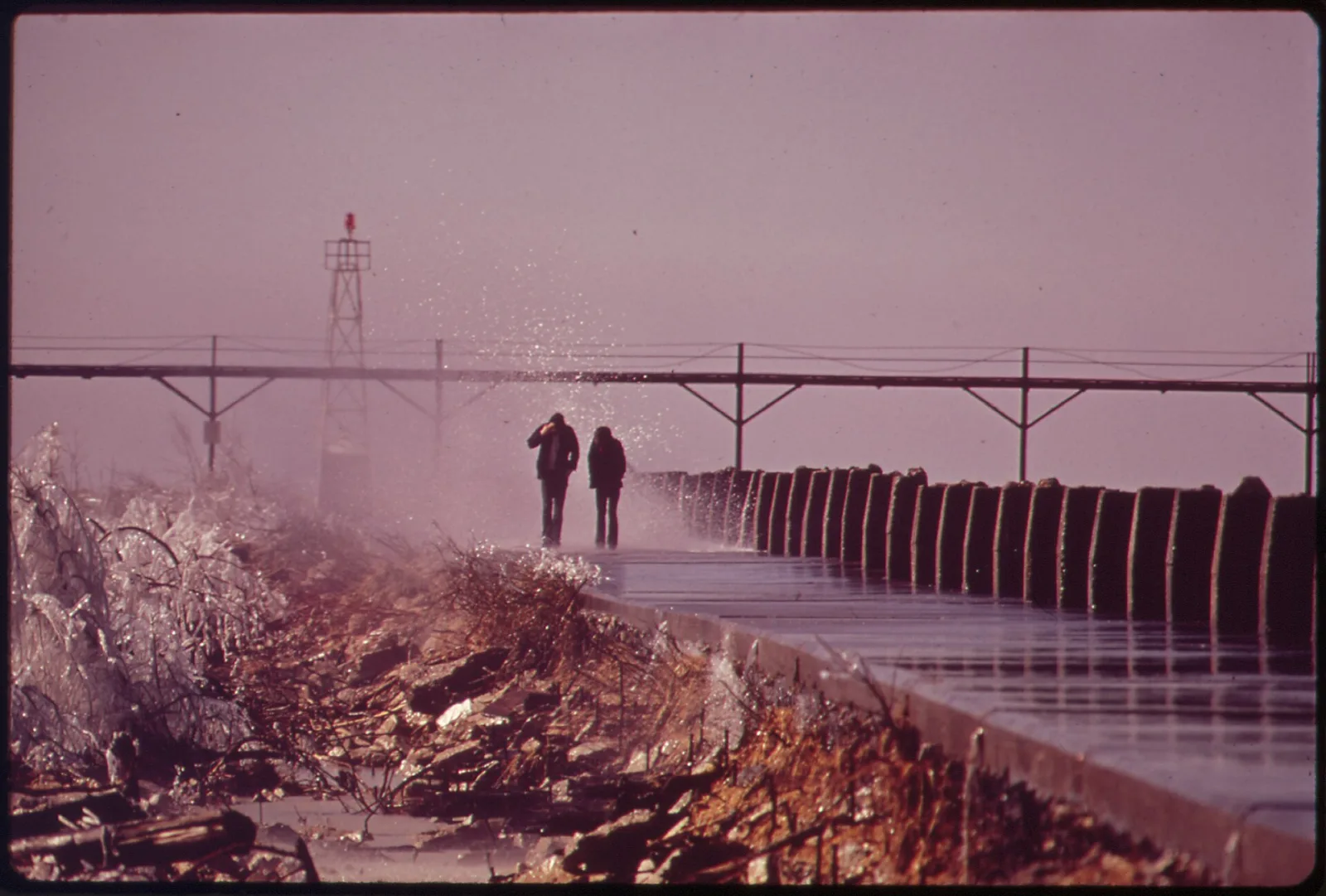 Icy wind drives waves over the Michigan City breakwater on Lake Michigan. Wind like this helps mix a lake. Photo: Paul Sequeira, via Wikimedia Commons · Public domain
Timing depends on the lake and its climate. Georgia DNR says Lanier's turnover generally comes around Christmas. Shape matters too: Water on the Web says Upper Midwest lakes deeper than about 33 feet (10 m) and larger than roughly 100 to 200 acres are probably dimictic, fully re-oxygenating at least for a while each fall.
Lake Minnetonka, with 14,004 acres and a maximum depth of about 112 feet (34 m), is one of its examples. Many shallower Minnesota lakes are polymictic instead, stirred by wind many times a year rather than locked into layers all summer.
Turnover is the lake's winter oxygen tank
Fall turnover matters most for what comes next. The AuSable River Association notes that once ice covers a lake, it seals the water off from the air and blocks much of the light that plants and algae need to make oxygen.
From then on, oxygen slowly declines all winter. If a lake stays frozen too long, levels can fall low enough to kill fish. The oxygen that fall mixing carried down to the bottom is, in effect, the supply the lake lives on until spring.
Turnover can also cut the other way. Nebraska's specialists warn that mixing spreads nutrients and decaying matter from the bottom through the whole lake, which is why some lakes smell unpleasant in fall. If turnover happens too quickly, oxygen can drop low enough to cause a fish kill.
It follows from the physics that deep lakes freeze later than shallow ones, because they have far more water to cool to 39°F before the surface can drop further. That is one reason small ponds and shallow bays often skim over first while the main basin stays open.
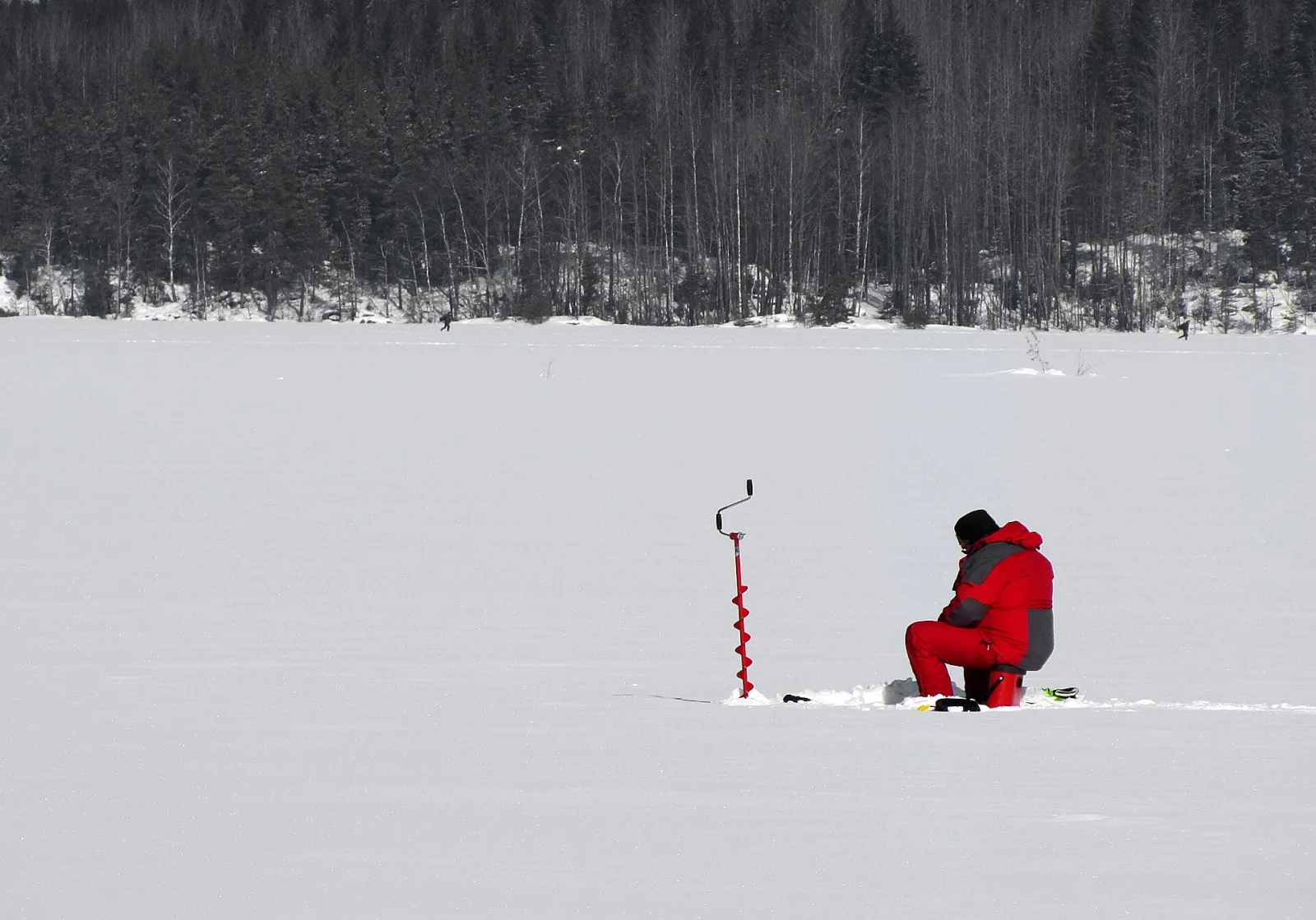 An angler fishes through the ice on Finland's Lake Saimaa, his auger standing in the snow beside him. Photo: Petritap, via Wikimedia Commons · CC BY-SA 3.0
What turnover means for your next trip
Southern reservoirs are mid-flip right now. In a November 25 report on Lake Lanier, Georgia Outdoor News listed water temperatures in the upper 50s, mixed clarity and "some turnover reported," with turnover-type water remaining in many areas.
A few things to keep in mind on the water this time of year:
- Expect odd water during the mix. Off-color water and a sulfur smell are signs of bottom water coming up. Clarity usually returns: Georgia DNR says dissolved metals settle out within a few days after Lanier turns over.
- Look deeper afterward. Once the lake has mixed, oxygen reaches the bottom again, so fish are no longer kept out of deep water. Spend time on basins and steep breaks you skipped all summer.
- Use the reservoir's shape. With Lanier about 9 feet below full pool, GON reports that fish move into ditches more reliably than at normal levels.
- Watch your temperature gauge. A surface reading falling through the 40s means the lake is nearing 39°F and the last stage before ice.
- Report dead fish. A fall die-off in a small lake or pond may be a rapid turnover. Call your state fisheries office so biologists can check.
After the mix, Georgia DNR says, Lanier's water runs cold, around 45 to 50°F, and clear, with plenty of oxygen top to bottom. For anglers it is a reset: the whole lake is livable again, and the fish have the room to use it.
Questions and answers
- How long does fall turnover last?
- It varies with the lake's size, depth and the weather. Mixing continues as the surface keeps cooling toward 39.2°F, and on a reservoir like Lake Lanier, Georgia DNR says dissolved metals settle out within a few days after turnover, when the water turns cold and clear.
- Do all lakes turn over in the fall?
- No. Shallow lakes are often mixed by wind many times a year and never hold strong summer layers. Water on the Web says Upper Midwest lakes deeper than about 33 feet and larger than about 100 to 200 acres are the ones likely to stratify and turn over twice a year.
- Why does the bottom of a frozen lake stay around 39°F?
- Water is densest at 39.2°F, so that water settles to the bottom. Colder water near 32°F is lighter and stays on top, right under the ice, which is why lakes freeze from the top down instead of solid from the bottom up.
Lakes in this story
Sources
- Water Density, U.S. Geological Survey Water Science School (read Nov 27, 2026)
- Density Stratification (Understanding Lake Ecology), Water on the Web, University of Minnesota Duluth (read Nov 27, 2026)
- Georgia DNR Explains Lake "Turnover", Georgia Department of Natural Resources, via The Fishing Wire (read Nov 27, 2026)
- Fall Turnover: A Physical Look at Lakes, University of Nebraska–Lincoln Water (read Nov 27, 2026)
- A Look Under the Ice: Winter Lake Ecology, AuSable River Association (read Nov 27, 2026)
- Lake Lanier Fishing Report – December 2026, Georgia Outdoor News (read Nov 27, 2026)